There is a specific disappointment that Palm Jumeirah homeowners describe when a villa renovation has not gone the way they hoped. It is not that the interior is badly designed in isolation. The furniture is good. The materials are premium. The finishes are clean. But something is wrong with the relationship between the inside of the villa and the outside, between the interior space and the water that is, in many cases, thirty meters from the living room glass.
The villa feels like a very good interior that happens to be on the Palm, rather than a home that belongs to the Palm.
This distinction sounds philosophical until you consider what Palm Jumeirah buyers are actually paying for. The premium attached to a Palm Frond villa over a comparable villa in Arabian Ranches or Dubai Hills is not primarily about the interior specifications. It is about the water, the private beach, the sea air, the light quality, and the particular spatial experience of living on a man-made island in the Arabian Gulf. A design approach that does not actively engage with those conditions and that treats the Palm villa as a generic Dubai villa brief with better views wastes the most valuable features of the property.
Getting it right requires understanding what makes Palm Jumeirah villas architecturally and contextually different from any other residential typology in Dubai: the frond layout, the coastal material conditions, the indoor-outdoor relationship that defines how the property lives rather than how it photographs, and the Nakheel-specific approval requirements that affect what can actually be built. This post covers all of it.
What Makes Palm Jumeirah Villas Different From Every Other Dubai Villa Community
The Frond Typology
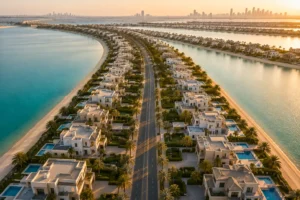
Palm Jumeirah’s residential structure is organized around sixteen fronds radiating from the trunk, each frond functioning as a semi-private cul-de-sac with between twenty and forty villa plots on each side. The frond configuration means that every plot has a defined relationship to its neighbours, to the frond road, and to the water, but that relationship differs significantly depending on where on the frond the plot sits.
A plot at the tip of the frond faces open sea on three sides and has the maximum water exposure, the maximum wind exposure, and the least privacy from passing boats and water activity. A plot in the middle section of the frond faces the lagoon between the fronds, with calmer water, better privacy, and a view that includes the neighbouring fronds as well as the open Gulf. A plot near the base of the frond is closer to the trunk infrastructure, has a shorter walk to the beach club and amenity facilities, and typically has a slightly different plot geometry that affects the villa’s orientation.
These are not trivial differences for a design brief. The tip villa requires a material specification that performs against maximum coastal exposure. The mid-frond villa has a water view that needs to be framed rather than simply revealed, the view is intimate and lagoon-like rather than open-ocean dramatic. The base-frond villa has different privacy considerations and a different relationship between the interior and the exterior depending on which direction the primary living spaces face.
A design firm approaching a Palm Jumeirah brief without understanding the specific frond position and what it means for orientation, exposure, and view line is starting from the wrong place.
The Three Villa Series
Palm Jumeirah’s residential villas were delivered in three primary configurations, Garden Homes, Signature Villas, and Canal Coves, plus the larger, individually designed properties on the Palm’s crescent.
Garden Homes are the most numerous category of four-bedroom villas on plots of approximately 6,000 to 7,000 square feet, with a ground-floor living and kitchen arrangement, four bedrooms across two upper floors, and a private garden and pool at the rear facing the lagoon. The layout is relatively standardized across the series, which means that design differentiation in garden home renovations comes almost entirely from the interior specification and the quality of the indoor-outdoor transition rather than from spatial reconfiguration.
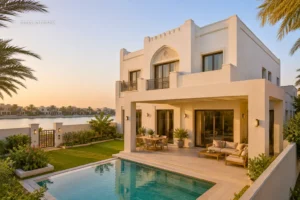
Signature Villas are larger five and six, bedroom configurations on plots of approximately 10,000 to 16,000 square feet with more generous living spaces, a more complex interior layout, and private beach access in addition to the rear lagoon garden. The design brief for a Signature Villa renovation is correspondingly more complex: more rooms to articulate, more transitions between indoor and outdoor zones, and a higher expectation of both spatial quality and material specification from buyers at this price point.
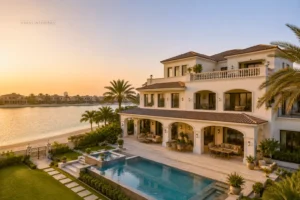
Canal Coves sit on the waterways running through the Palm Trunk area rather than on the fronds, with a different water orientation facing a canal rather than the open lagoon and a somewhat different plot geometry. They are less numerous than Garden Homes and Signature Villas but represent a distinctive brief because the canal-facing orientation creates a more urban waterfront condition than the open-lagoon frond plots.
Understanding which villa type you are designing for changes the approach before a single material or furniture decision is made.
The Waterfront Design Challenge: What Coastal Conditions Actually Do to Interiors
This is the section that most Palm Jumeirah interior design content either ignores entirely or handles at a superficial level. It deserves more than that, because the consequences of not specifying for coastal conditions are expensive, not in the first year but in years two through five, when materials that looked impeccable at handover begin to show the specific degradation patterns of a high-humidity, high-salinity, high-UV coastal environment.
Palm Jumeirah’s coastal conditions are meaningfully more demanding than those of inland Dubai communities and significantly more demanding than UK or European coastal conditions that some imported European design thinking is calibrated for. The combination of high ambient humidity (the palm sits in the water, which means the air around the property is consistently more humid than ten kilometers inland), salt-laden sea breezes from the Gulf, and UV intensity that significantly exceeds most European coastal environments creates conditions that accelerate material degradation in specific and predictable ways.
What the Coastal Environment Does to Joinery
Solid timber joinery, the material of choice for luxury interiors in cooler, drier climates, performs poorly in sustained high-humidity coastal environments when it is in proximity to the outdoor-indoor transition zone. Expansion and contraction from humidity cycling causes joint failure in traditionally constructed solid timber joinery within three to five years. Doors warp. Drawer faces misalign. Mitred corners open. The quality that was evident at installation becomes a maintenance liability.
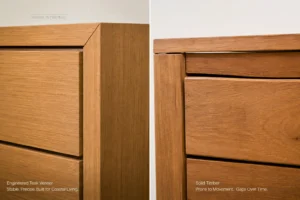
The solution is not to abandon timber aesthetics, which would eliminate one of the most beautiful material options for a coastal villa. It is to specify engineered timber substrates with natural timber veneers for fixed joinery, marine-grade plywood for concealed joinery carcasses, and solid timber only for elements that are not in the humidity-affected zone or that have sufficient mass and appropriate species selection to manage movement without failure.
Timber species selection matters significantly. Teak is expensive but performs exceptionally well in coastal conditions it has natural oil content that resists moisture absorption and a stable grain structure that minimizes movement. Oak and ash are workable with appropriate substrate engineering. Pine, MDF, and particle board are common cost-reduction choices in joinery construction, they degrade rapidly in coastal humidity and should not be used in any part of a Palm Jumeirah villa joinery specification, including concealed elements.
What the Coastal Environment Does to Metal Finishes
Brushed gold, aged brass, and matte black metal fixtures and hardware, all popular finish choices in luxury residential interiors across Dubai, respond differently to salt-laden coastal air than they do in inland environments.
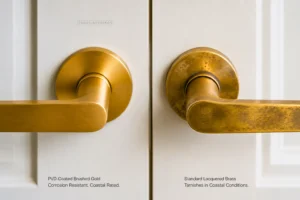
Untreated or standard-lacquered brass and gold-toned hardware tarnishes and develops surface corrosion in coastal humidity at a rate that is three to four times faster than comparable installations in inland Dubai. Matte black powder-coated finishes on outdoor and outdoor-adjacent elements, door handles, window hardware, external light fixtures, and outdoor kitchen hardware, develop corrosion patching within eighteen to twenty-four months in direct coastal exposure.
The specification solution is marine-grade or PVD-coated hardware for all outdoor and transition zone elements and a clear understanding of which interior zones are affected by the humidity migration from the outdoor-indoor boundary. In a Palm villa, this typically means all hardware within approximately three meters of any external door or window that opens regularly, including internal doors adjacent to those openings, should be specified to a higher corrosion-resistance standard than the same hardware choice would require in a Business Bay apartment.
What the Coastal Environment Does to Upholstery
Standard residential upholstery fabrics are not specified for the UV intensity and humidity combination present on the Palm. Fabric-upholstered sofas placed near floor-to-ceiling glazing with direct afternoon sun exposure, which in a Palm villa’s lagoon-facing living room means consistent south-west exposure for four to six hours per day, will show UV fading within eighteen months in natural and low-saturation fabrics.
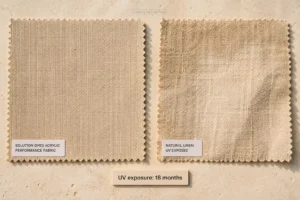
High-quality solution-dyed acrylic performance fabrics (brands such as Sunbrella and Dickson are the most reliably specified for coastal conditions) resist UV fading and humidity-related mold growth significantly better than standard residential upholstery and are available in a sufficiently wide range of textures and weights to be specified for indoor furniture rather than only outdoor pieces. The cost premium over standard fabric is real but modest compared to the cost of reupholstering a full living room suite within two years.
For outdoor and covered terrace furniture, the performance fabric requirement is non-negotiable. Teak or powder-coated aluminum frames with solution-dyed acrylic cushioning is the functional specification baseline. Natural rattan and standard powder-coated steel are both inadequate for direct coastal outdoor conditions on the palm, regardless of how well they look in showroom conditions.
Indoor-Outdoor Living: The Defining Brief
If there is a single design principle that governs every good Palm Jumeirah villa project, it is this: the indoor-outdoor relationship is not a feature of the brief, it is the brief.
Palm Jumeirah buyers pay a premium that is measured in millions of dirhams for the private garden, the pool, the lagoon access, and the private beach. A design that does not actively engage with these outdoor elements, that treats the garden as a backdrop to a conventionally enclosed interior, is leaving the most valuable features of the property unaddressed.
This has concrete design implications across every area of the villa.
The Living Room as Indoor-Outdoor Space
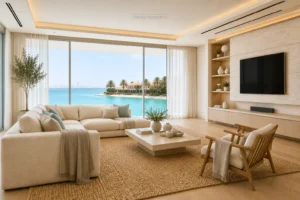
In a Palm Garden Home or Signature Villa, the primary living room typically faces the rear garden and pool area, with floor-to-ceiling glazing and a set of folding or sliding glass doors that open the entire rear wall to the outdoor zone. When these doors are fully open, the interior and exterior become a single continuous space, the inside living area flows without physical boundary into the covered terrace, pool deck, and garden.
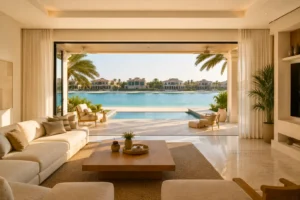
Designing this space well means designing both sides of the boundary as a single composition, not as two separate briefs with a wall between them. The flooring material should continue from interior to exterior with minimal transition, ideally the same material inside and out, or a closely related material in the same tonal family. The furniture arrangement inside the room should consider sightlines from the poolside back into the interior as well as sightlines from the sofa toward the garden. The lighting scheme should consider the evening condition when the pool illumination becomes the primary light source visible from the interior.
Our living room design approach for Palm villas always begins with this interior-exterior compositional analysis before any furniture or material decisions are made. The most common error we see in Palm Villa living rooms that were designed without this approach is a room that functions well in isolation but feels disconnected from the outdoor space, a visual gap between the interior aesthetic and the outdoor zone that the folding doors cannot bridge because the two sides were never designed as a single composition.
The Covered Terrace as the Villa’s Most Used Space
In the Palm Jumeirah climate, where outdoor conditions are comfortable for approximately seven months of the year and challenging for five, the covered terrace is, in practice, the most used room in the house for most owner-occupier Palm villa residents. It is where families have breakfast, where evening entertaining happens, where the daily transition between the air-conditioned interior and the outdoor pool and garden is managed.
A covered terrace that has been designed as an afterthought, generic outdoor furniture purchased independently of the interior design brief, inadequate lighting for evening use, and no consideration for the acoustic comfort of an outdoor room adjacent to a reflecting pool fail to deliver on the Palm Jumeirah premium regardless of how good the interior is.
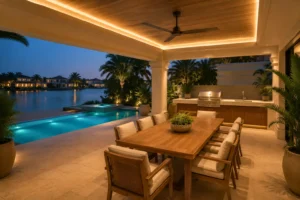
The covered terrace brief should include flooring that integrates with both the interior material and the pool deck material; a lighting scheme that provides ambient, task, and accent levels comparable to the interior; outdoor kitchen or servery facilities that make the space genuinely self-sufficient for entertaining; acoustic treatment through soft furnishings and landscape planting that reduces the reflective echo from hard water and tile surfaces; and ceiling fans or an outdoor cooling system for the transitional months when the temperature is manageable but not comfortable in still air.
The Pool Deck and Garden
Pool deck design at the Palm is not purely a landscape decision it is an interior design decision that affects how the villa reads from inside. The material, colour, and pattern of the pool deck tile or stone is visible from the living room, the kitchen, the covered terrace, and, in many Garden Home layouts, from multiple bedrooms. Getting it right means selecting it within the same material consideration process as the interior floor finishes, not commissioning it separately from a landscaper after the interior is complete.
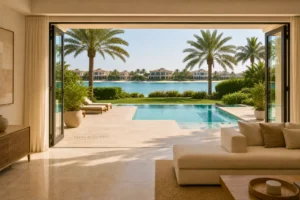
Travertine and light limestone are the traditional Palm pool deck materials, and they work well they stay relatively cool underfoot, they look elegant in photographs, and they integrate naturally with the white and cream architectural palette of most Palm villas. Large-format porcelain in a stone appearance is increasingly used as an alternative with better durability and lower maintenance requirements. Dark stone and dark-toned tiles should be avoided for pool deck surfaces where barefoot use is expected the heat absorption in direct Gulf sun creates a surface temperature that is genuinely hazardous.
The Master Suite: Private Retreat with a Water View
The master bedroom in a Palm Jumeirah villa, particularly in the Signature Villa series is frequently positioned to offer a water view, either over the rear garden to the lagoon or, in some frond-tip properties, with a direct sea view from multiple facades. The design brief for this space is defined by the tension between the desire to fully reveal that view and the need for privacy, thermal comfort, and the kind of deeply restful atmosphere that makes a master suite function as a retreat rather than a hotel room.
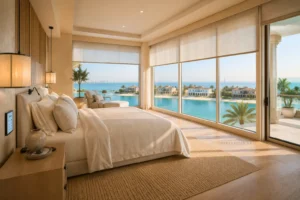
Our bedroom interiors approach in Palm villas specifically addresses this tension through three design decisions made simultaneously:
Window treatment layering. A motorized solar sheer that preserves the view while managing glare and heat gain during the day, combined with a motorized blackout blind for sleeping and privacy. The operation of both layers from a single bedside control (or integrated into the home automation system) is the standard specification for Palm master suites at this price point.
Bedroom orientation analysis. The master bed’s position should be established relative to the water view before any other furniture placement decision, not because the bed always needs to face the view, but because the relationship between where you sleep and what you see when you wake up is the most personal spatial experience in the house, and it deserves to be decided deliberately rather than by default.
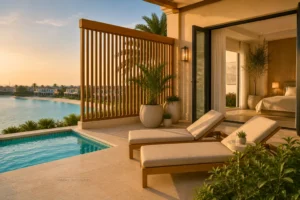
Outdoor master terrace integration. Many Signature Villa master suites have a private terrace accessible directly from the bedroom, a space that in well-designed projects functions as an extension of the master suite rather than a generic balcony. A private plunge pool, a pair of sun loungers, a privacy screen in landscape planting, or a timber batten screen that does not obstruct the view, these elements, specified within the same design brief as the bedroom interior, transform the master suite from a single room into a private residential zone.
Material Specifications That Perform: What Works and What Doesn’t
Drawing together the coastal condition considerations above into practical material guidance:
Stone
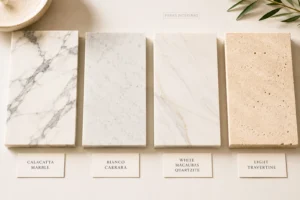
Indoor flooring: White and cream marbles (Calacatta, Bianco Carrara, and White Macaubas quartzite) work extremely well in Palm Villa interiors. They are cool underfoot, they read as native to the coastal-luxury aesthetic, and they are not materially affected by the humidity conditions in an air-conditioned interior. Polished finish in living areas and honed finish in bathrooms and wet areas.
Outdoor and transition zones: Travertine, limestone, and large-format porcelain in light tones for pool decks and covered terraces. Avoid polished stone in any outdoor or wet-area application, it becomes dangerously slippery when wet.
Feature walls: Book-matched marble or stone on indoor feature walls adds significant visual impact and is not adversely affected by coastal conditions when fully indoors. Avoid natural stone feature walls in covered outdoor terraces, the humidity cycling causes efflorescence (mineral salt deposits) that disfigures the stone face over time.
Timber
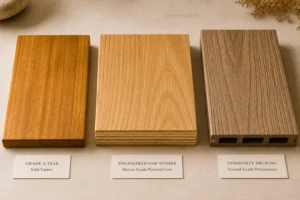
Interior joinery: Engineered substrates with natural timber veneers. Solid timber only for elements with appropriate species selection and away from humidity-affected zones. Teak for any elements in transition zones or outdoor-adjacent areas.
Outdoor furniture frames: Teak or powder-coated aluminium only. Grade A teak without treatment is the material of highest durability for outdoor furniture in Gulf coastal conditions. Powder-coated aluminium is lighter, more contemporary, and entirely adequate in most coastal exposure conditions with appropriate coating specifications.
Decking: Composite decking boards have largely replaced solid timber decking in Palm Villa projects at the specification level we work at, they perform better in sustained UV and humidity exposure, require no annual oiling or maintenance, and have reached a quality level where the visual difference from natural timber is minimal. Solid teak decking remains the premium option but requires maintenance discipline that most villa residents do not sustain.
Fabric and Soft Furnishings
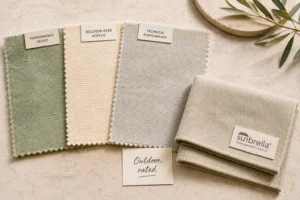
Interior upholstery: Performance velvet or technical fabric for sofas and seating. Solution-dyed acrylic for any piece within three meters of a regularly opened external glazing panel. Natural linen and cotton are aesthetically beautiful but require the same UV and humidity caution in coastal exposure zones as in any Dubai coastal property.
Outdoor upholstery: Solution-dyed acrylic (Sunbrella grade or equivalent) without exception. No natural fiber cushioning in any outdoor or covered terrace application.
Window treatments: Motorized solar sheers in a fabric rated for the specific glazing orientation, south and west-facing glazing requires a higher openness factor (more heat rejection) than north or east-facing glazing. Motorized blackout for bedrooms and media rooms.
Metal Finishes
Indoor hardware, inland from external glazing: Standard luxury residential hardware is appropriate, brushed gold, aged brass, and matte black all work at this remove from the coastal environment.
Hardware within three meters of external openings, or in any outdoor-adjacent space: PVD-coated or marine-grade specification. The aesthetic difference between PVD-coated brushed gold and standard lacquered brushed gold is imperceptible. The performance difference at five years in coastal conditions is dramatic.
Smart Home Integration: Baseline, Not Premium
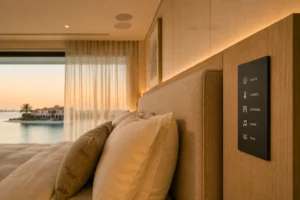
Palm Jumeirah buyers at the Signature Villa price point and increasingly at the Garden Home price point arrive with an expectation of whole-home automation as a standard feature rather than an optional upgrade. The expectation covers motorized window treatments, multi-zone audio, climate control zoning, pool and garden lighting automation, security and access control, and a single-interface control system that integrates all of these functions.
The problem with treating smart home integration as a separate contractor’s scope handed to an AV or home automation specialist after the interior design brief is finalized is that the physical infrastructure required to deliver a seamlessly integrated smart home needs to be built into the construction works during the fit-out phase, not retrofitted afterward. Conduit routes for wiring, in-ceiling speaker positions, motorization housing for window treatment systems, control panel locations, and network infrastructure for a property with dozens of connected devices, all of these require physical decisions that are made during the design phase and cannot be cost-effectively changed once walls are closed and ceilings are boarded.
Paras Interiors’ approach to smart home integration in Palm Jumeirah villa projects is to include it in scope from the concept development phase, working with the home automation contractor during the design phase rather than handing it off to them after design completion. This means that the motorized window treatment is specified in coordination with the curtain track infrastructure, not independently. The in-ceiling speaker positions are designed alongside the ceiling layout, not drilled through a completed ceiling plaster after the fact. The control interface locations are considered relative to furniture arrangement and daily movement patterns in the villa, not placed wherever a cable happened to terminate.
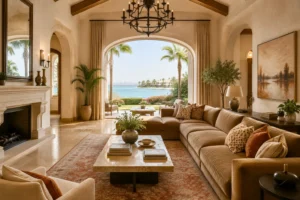
The result is a smart home system that feels like it was designed into the villa rather than installed in it, which is exactly the difference between a Palm Jumeirah home that functions at the level its price point implies and one that has good individual components that do not form a coherent whole.
Paras Interiors and Palm Jumeirah: The Design Approach
Our luxury villa interior design work covers Palm Jumeirah alongside the full range of Dubai’s premium villa communities, and the Palm brief is one that our team approaches with a specific coastal design methodology that differs from our standard Dubai villa process.
The coastal material specification review, assessing every specified material and finish against the performance requirements of the Palm’s specific environmental conditions, is part of our design development process for every Palm project, not an optional add-on. The indoor-outdoor compositional analysis happens before furniture and material selections are presented to the client, not after. And the Nakheel NOC advisory, setting expectations about what requires approval, what does not, and how that affects the project timeline, is part of the initial briefing conversation rather than a discovery that surfaces mid-project.
If you are considering a Palm Jumeirah renovation or a first-time fit-out of a villa on the fronds, the conversation about design scope and approach should start before you have finalized your brief because the brief will be better for having the coastal conditions, the villa typology, and the indoor-outdoor relationship established as first principles rather than as afterthoughts.
You can browse our luxury villa portfolio to understand the range of projects we have delivered and reach out to discuss your Palm Jumeirah brief whenever you are ready to begin.
For readers comparing Palm Jumeirah with other premium Dubai villa communities, our work in Dubai Hills covers the mainland villa brief in detail, and our interior design cost per square foot guide gives specific pricing benchmarks across different finish tiers. For those considering penthouse apartments on the Palm or elsewhere in Dubai, our Dubai penthouse interior trends post covers the high-rise luxury brief with the same level of specificity.