The decision to move from Dubai to Abu Dhabi rarely happens gradually. It tends to arrive as a specific event: a government sector appointment, a corporate relocation package, or a family that has done the calculation and realized that the villa they cannot afford in Arabian Ranches exists comfortably within budget in Khalidiyah or Mohammed Bin Zayed City. Whatever the trigger, the result is the same, you are starting fresh in a new home, in a new emirate, and the interior design decisions you make in the first few months will shape how that home feels for the next several years.
This is a fundamentally different brief from renovating an existing home. When you renovate, you are working around accumulated furniture, personal history, and the constraints of a space you already know. When you relocate, you are making decisions quickly, often remotely, sometimes before you have spent more than a few hours in the actual property. The risk of getting it wrong is higher, and the cost of correcting mistakes is compounded by the disruption of settling into a new city simultaneously.
This post exists to give you the specific, honest comparison between interior design services in Dubai and interior design services in Abu Dhabi that most content in this space avoids providing: real cost benchmarks by finish tier, accurate timeline expectations for both municipalities, an honest account of the supply chain differences between the two markets, and a clear answer to the question we get asked most often by relocating clients. Does it cost more to design and fit out a home in Abu Dhabi than in Dubai?
The short answer is it depends on property type more than it depends on location. The longer answer follows.
Who Actually Moves from Dubai to Abu Dhabi, and Why It Matters for the Design Brief
Understanding the relocating client profile matters because different relocation contexts produce genuinely different design briefs, and a firm that does not understand why you are moving cannot serve you as well as one that does.
Government and semi-government sector hires represent a significant proportion of Dubai-to-Abu Dhabi relocations. These clients are typically moving into Abu Dhabi for the first time, often on accelerated timelines dictated by a start date rather than a personal preference, and frequently relocating families that have been established in Dubai for years. The design brief here is usually about replicating a level of comfort and permanence quickly, not experimenting with a new aesthetic but getting a family home functional and settled within a tight window. Speed of delivery and project management reliability matter more than they do for a client with an open timeline.
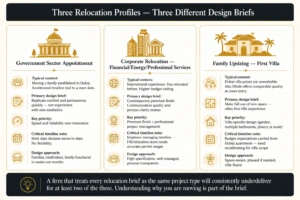
Corporate relocations in the financial, energy, and professional services sectors follow a similar pattern but often with a higher budget ceiling and a stronger preference for contemporary premium finishes. The client has moved internationally before, knows what they want, and is evaluating the interior design firm as much on communication quality and process clarity as on portfolio aesthetics.
Families upsizing on a budget are perhaps the most practically motivated segment. Dubai has pushed villa prices, both purchase and rental, to levels that are increasingly unworkable for families who want a four-bedroom home with a garden. Abu Dhabi’s villa communities offer comparable quality at a meaningfully lower price point, and the families who make this move are often doing so after years of compromising on space in Dubai. The design brief here is typically about making full use of the additional square footage they have gained, often their first experience of designing a villa rather than an apartment, which requires a different approach than the high-rise-specific work that dominates the Dubai portfolio.
Each of these client profiles arrives with a different relationship to the design process: different timelines, different budget structures, different levels of prior experience with interior design firms, and different emotional contexts for the relocation. The design work that serves them well is not identical, and a firm that treats every relocation brief as the same project type will consistently underdeliver for at least two of the three.
Cost Comparison: What Interior Design and Fit-Out Actually Costs in Dubai vs Abu Dhabi
This is the section most people reading this post have come for, so we will be direct and specific.
The benchmarks below reflect Paras Interiors‘ actual project delivery across both markets. We have structured them by finish tier rather than by room type, because the tier decision is typically made first and determines everything downstream. Where we give ranges, those ranges reflect real variation by property size, scope of custom joinery, and the complexity of the specific brief, not an artificially wide range designed to avoid commitment.
Standard Finish Tier
Standard finish covers functional design with quality but non-luxury materials, ready-made or semi-custom furniture, standard-grade tile and stone, off-the-shelf sanitaryware and fittings, recessed lighting without complex control systems, and painted or wallpapered walls without bespoke paneling.
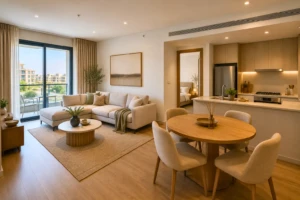
This tier suits rental investment properties, transitional homes where the client anticipates moving again within three to five years, or first-time fit-outs where the priority is getting the home liveable quickly and well without committing to the highest specification level.
- Dubai (apartment, 1–2 bedroom): AED 120,000 – AED 220,000 for full-scope delivery including furniture, fixtures, and finishing works.
- Abu Dhabi (apartment, 1–2 bedroom): AED 115,000 – AED 210,000 for a comparable scope.
- Dubai (villa, 3–4 bedroom): AED 280,000 – AED 450,000 depending on villa size and condition of handover.
- Abu Dhabi (villa, 3–4 bedroom): AED 260,000 – AED 430,000 for a comparable scope.
The Abu Dhabi figure is marginally lower at the standard tier, primarily because Abu Dhabi villa communities tend to have a cleaner, more straightforward handover condition than older Dubai stock, less remediation of previous fit-out work, and fewer structural surprises on opening walls.
Premium Finish Tier
Premium finishes cover designer or custom furniture; natural stone (marble, travertine, and quartzite) for kitchen and bathroom surfaces custom joinery in living areas and master bedrooms; mid-to-high-specification sanitaryware brands (Grohe, Hansgrohe, and TOTO); and a considered lighting scheme with some level of dimming control.
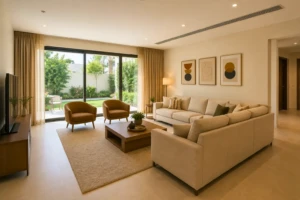
This is the tier that the majority of owner-occupier clients in both markets choose when they are designing a home they intend to live in for five or more years.
- Dubai (apartment, 2–3 bedroom): AED 280,000 – AED 550,000.
- Abu Dhabi (apartment, 2–3 bedroom): AED 260,000 – AED 520,000.
- Dubai (villa, 4–5 bedroom): AED 550,000 – AED 950,000.
- Abu Dhabi (villa, 4–5 bedroom): AED 500,000 – AED 900,000.
At the premium tier, the Abu Dhabi cost advantage is real but not dramatic. The primary variable is not location but square footage, Abu Dhabi villas are frequently larger in gross area than comparable-bedroom-count Dubai villas, which means more flooring, more joinery, and more sanitaryware across more bathrooms. A client who is upsizing significantly from a Dubai apartment to an Abu Dhabi villa should budget for the additional area even if the per-square-foot cost is similar or slightly lower.
Luxury Finish Tier
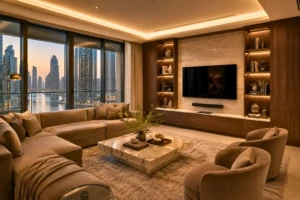
Luxury finishes cover fully custom furniture; exotic or book-matched natural stone, Italian or European designer kitchen systems (Bulthaup, Poliform, Boffi); high-specification sanitaryware (Duravit, Villeroy & Boch, Vola), comprehensive smart home lighting and climate control; window treatments from specialist suppliers; and art curation or commissioning as part of the design scope.
- Dubai (apartment, 2–3 bedroom): AED 600,000 – AED 1,500,000+.
- Abu Dhabi (apartment, 2–3 bedroom): AED 580,000 – AED 1,400,000+.
- Dubai (villa, 4–6 bedroom): AED 1,200,000 – AED 3,500,000+ depending on size and specification.
- Abu Dhabi (villa, 4–6 bedroom): AED 1,100,000 – AED 3,200,000+ for comparable specifications.
At the luxury tier, the cost difference between cities is essentially immaterial relative to the specification choices. Whether a project lands at AED 1.5 million or AED 2.5 million has almost nothing to do with which emirate the property is in and almost everything to do with whether the kitchen is a semi-custom European system or a fully bespoke Italian one, whether the stone is sourced from Italy or Spain, and how extensively the joinery and ceiling work is developed.
What These Figures Do Not Include
Design fees are structured separately from fit-out costs across all tiers and are discussed transparently during the initial consultation. Permit and approval fees for works requiring municipality notification are separate line items and are covered in the timeline section below. Furniture procurement has its own cost structure depending on whether items are sourced locally, imported from the GCC, or shipped from Europe.

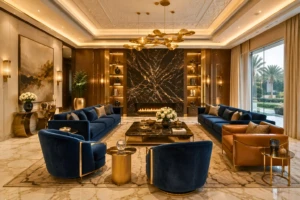
If you want an accurate scope and budget specific to your Abu Dhabi property, contact us directly with the property details, building type, approximate size, and the scope of works you are considering, and we will provide a realistic range before any commitment is made.
Timeline Comparison: Dubai Municipality vs Abu Dhabi Municipality
The timeline is where the two markets diverge most meaningfully in practice, and it is the area where relocating clients are most frequently caught out by assumptions carried over from previous Dubai project experience.
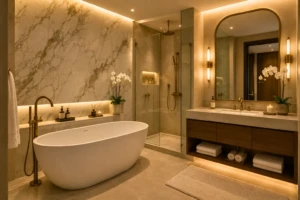
Dubai Municipality Process
For interior fit-out works within an existing apartment or villa that do not involve structural changes, which covers the majority of residential interior projects, Dubai Municipality does not require a permit for cosmetic and non-structural works. This means that a standard fit-out involving new flooring, joinery, painting, bathroom fixture replacement, and kitchen renovation can proceed without a formal approval stage once the building’s NOC (No Objection Certificate) has been obtained from the building management.
The NOC process in most Dubai residential buildings takes between three and ten working days, depending on the building management company’s responsiveness and whether the works fall within a scope that the building’s standard NOC framework already covers.
For works that do involve structural changes, alterations to wet areas in ways that affect slab penetrations, or any modification to the building’s MEP (mechanical, electrical, and plumbing) systems, a DM permit is required. This typically takes three to six weeks from complete application submission, assuming no queries are raised on the drawings.
Typical fit-out duration in Dubai once works commence:
- One-bedroom apartment, standard finish: 6–8 weeks
- Two-to-three-bedroom apartment, premium finish: 8–12 weeks
- Villa, 4–5 bedroom, premium finish: 12–18 weeks
- Villa, luxury finish with custom joinery and stonework: 18–28 weeks
Abu Dhabi Municipality Process
Abu Dhabi’s approval framework for residential interior works is structured differently from Dubai’s, and the differences have practical consequences for project timelines.
The Abu Dhabi Department of Municipalities and Transport (DMT) requires a permit for a broader category of works than Dubai Municipality does. Specifically, any works that involve modification to internal partitions, changes to bathroom or kitchen layouts, or alterations to MEP systems require a permit submission regardless of whether structural elements are involved. This is not necessarily more burdensome in absolute terms it is simply a different threshold for what triggers the formal approval requirement.
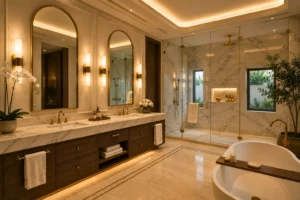
The permit process for residential interior works in Abu Dhabi typically runs four to eight weeks from complete submission, with the timeline heavily influenced by whether the drawings submitted are complete and compliant on first submission or require revisions. Projects that submit complete, municipality-standard drawings on the first attempt consistently achieve approvals at the lower end of this range. Projects that submit incomplete packages or require drawing revisions add three to five weeks to the approval phase.
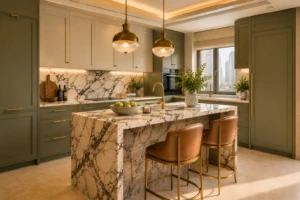
NOC requirements in Abu Dhabi also vary by building type and master developer. Government housing units (properties within Abu Dhabi Housing Authority communities) have a distinct NOC process that requires ADHA approval in addition to municipality permits, and this process can take an additional two to four weeks. Private developer communities (Aldar properties, for example) have their own NOC processes that are generally more straightforward.
Typical fit-out duration in Abu Dhabi once permits and NOCs are in place:
- One-bedroom apartment, standard finish: 7–9 weeks
- Two-to-three-bedroom apartment, premium finish: 9–13 weeks
- Villa, 4–5 bedroom, premium finish: 13–20 weeks
- Villa, luxury finish: 20–30 weeks
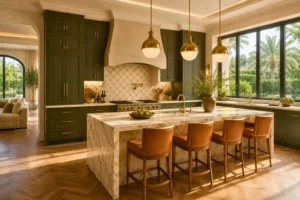
The Abu Dhabi timelines are slightly longer than Dubai equivalents at most scope levels, reflecting both the additional permitting requirements and the logistics of operating in a market where the trade contractor pool is somewhat smaller than Dubai’s and where material deliveries from Al Quoz or Jebel Ali add a transit stage that is not present for Dubai projects.
What This Means for Relocation Planning
If you are moving from Dubai to Abu Dhabi with a specific move-in date tied to a school year, a contract start, or a tenancy end date, the realistic planning sequence is:
- Engage your interior designer a minimum of six weeks before your intended permit submission date, allowing time for site visit, concept development, drawing production, and scope finalization.
- Submit permit applications and NOC requests simultaneously rather than sequentially; these processes can run in parallel in most cases.
- Allow for the full upper end of the approval range (eight weeks) in your timeline rather than planning against the lower end.
- Do not schedule furniture deliveries or final finishing works until structural and joinery works are confirmed complete; the most common cause of timeline overrun in Abu Dhabi residential projects is trades sequencing that was planned too optimistically.

For corporate relocations where the employer is managing a timeline, we recommend sharing the realistic permit duration range with the HR or relocation management team early, not because the timeline is problematic, but because it needs to be factored into temporary accommodation planning accurately.
Material and Supply Chain: What Changes When You Leave Al Quoz Behind
Dubai’s Al Quoz design district is one of the most concentrated collections of furniture showrooms, tile warehouses, stone suppliers, lighting specialists, sanitaryware galleries, and fabric suppliers in the region. For Dubai-based projects, this concentration of supply is a genuine advantage; trade sourcing visits can cover six suppliers in a single day, sample turnaround is immediate, and deliveries to sites in Dubai Marina, Downtown, or Dubai Hills are typically measured in hours or days rather than days or weeks.
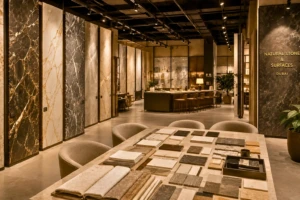
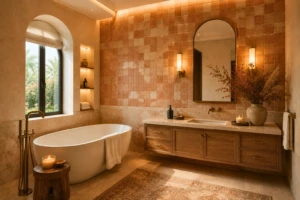
Abu Dhabi has its own furniture and design retail sector, the Bain Capital area, Hamdan Street, and the newer retail developments in Yas and Saadiyat include a reasonable selection of mid-to-high-end furnishing options, but they do not replicate the depth and density of the Al Quoz ecosystem. This has practical consequences for Abu Dhabi projects that are worth understanding before the specification process begins.
What This Means for Material Lead Times
For standard and premium tier materials that are stocked by major UAE distributors, porcelain tiles from the main Italian importers, engineered stone from leading fabricators, sanitary ware from the main brand distributors, and standard upholstery fabrics, there is no meaningful difference in lead time between Dubai and Abu Dhabi projects. These materials move through distribution networks that serve both markets, and the one-to-two day delivery differential from Dubai warehouses to Abu Dhabi sites is commercially immaterial.

Where lead times diverge is in bespoke and specialty items: custom upholstery orders placed with Dubai workshops, bespoke joinery fabricated in Al Quoz, made-to-measure curtains from Dubai specialist suppliers, or stones that need to be cut and fabricated before delivery. For these items, the fabrication lead time is unchanged, but the delivery and installation coordination adds a logistical layer for Abu Dhabi projects that can add three to five working days to scheduling cycles. This is manageable with proper planning but creates problems when it is not anticipated.
Material Selection That Works Better in Abu Dhabi
There are some material categories where Abu Dhabi projects benefit from Abu Dhabi-based sourcing rather than relying on Dubai supply chains:
Local stone and tile. Abu Dhabi has several well-stocked tile and stone distributors with display warehouses that carry comparable ranges to Al Quoz alternatives. For projects where the specific stone selection is not highly prescriptive, where the brief calls for “a premium light marble” rather than a specific slab, local Abu Dhabi sourcing can reduce lead time and simplify the logistics.
Soft furnishings and curtain fabrics. Abu Dhabi has a mature soft furnishings market with skilled local workrooms that can produce curtains, cushions, and upholstery to a high standard. For projects where custom soft furnishings are a significant cost component, local Abu Dhabi workrooms are often more cost-effective than Dubai workrooms plus Abu Dhabi delivery and installation.
Outdoor and landscape materials. For Abu Dhabi villa projects with significant garden or terrace scope, local landscape material suppliers are better positioned than Dubai-sourced alternatives simply because of the additional logistical complexity of large-format outdoor materials over the Abu Dhabi, Dubai route.
The Honest Reality for Luxury-Tier Material Sourcing
At the luxury finish tier, where the specification includes Italian marble sourced from specific quarries, European furniture brands, or bespoke joinery in exotic timbers, the supply chain reality is the same regardless of whether the project is in Dubai or Abu Dhabi, materials are being imported, lead times are set by the shipping schedule, and the location of the project within the UAE is not the variable that determines when items arrive. A Poliform kitchen system ordered for an Abu Dhabi project has the same 14-to-18-week lead time as the same system ordered for a Downtown Dubai apartment.
Property Type Differences: Why the Same Budget Lands Differently
This is one of the most practically important points in this comparison, and it is consistently underestimated by clients who are relocating with a budget that worked for their previous Dubai project.
Dubai’s residential stock, particularly in the premium market, is heavily weighted toward apartments. The high-rise towers of Dubai Marina, Downtown, Business Bay, and JVC define the budget expectations for most clients who have previously commissioned interior design work in Dubai. Apartment interior design has a specific cost structure: a defined square footage, a small number of wet areas, no exterior scope, and a relatively predictable joinery requirement.
Abu Dhabi’s premium residential stock is far more villa-weighted. The communities of Al Reem Island, Saadiyat, Yas, Al Reef, Mohammed Bin Zayed City, and Khalidiyah all include significant villa and townhouse inventory, and many relocating clients, particularly families, are moving into this property type for the first time.
What Changes When You Move From Apartment to Villa
The wet area count multiplies. A Dubai two-bedroom apartment typically has two bathrooms. An Abu Dhabi four-bedroom villa typically has four to six bathrooms, depending on whether the maid’s room, guest bathroom, and master suite are counted separately. A bathroom fit-out is one of the highest per-room cost items in any residential project, sanitary ware, tiling, shower screens, fixtures, and ventilation are all concentrated in a small space. Moving from two bathrooms to five has a disproportionate budget impact.
Joinery scope increases non-linearly. Wardrobes, kitchen cabinetry, utility room storage, and any study or library joinery all scale with property size. A villa that is two and a half times the square footage of an apartment does not require two and a half times the joinery, it often requires three to four times the joinery, because the number of rooms requiring bespoke storage multiplies while the per-room size remains roughly constant.
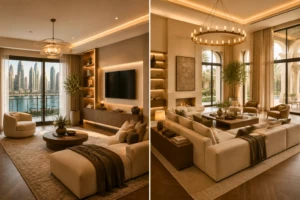
Outdoor scope introduces a new cost category. Villa projects almost always have a garden, terrace, or pool surround scope that simply does not exist in apartment projects. Outdoor furniture, landscape materials, terrace tiling, and external lighting are entirely new budget lines for clients relocating from apartment living.
The kitchen is larger. Abu Dhabi villa kitchens are consistently larger than Dubai apartment kitchens, and kitchen joinery is priced by linear metre. A villa kitchen that requires twelve linear meters of cabinetry costs proportionally more than an apartment kitchen requiring seven, regardless of the finish grade.
None of this means a villa fit-out is poor value, in fact, the cost per square foot of a villa fit-out typically compares favorably to a premium apartment fit-out in the same finish tier because the fixed costs (design, project management, and appliances) are spread across more usable area. But the absolute budget required is higher, and clients who carry their apartment project budget expectations into a villa brief consistently find themselves either compromising on finish tier or experiencing budget shock partway through the specification process.
Our home interior design services approach for villa projects in Abu Dhabi includes a phased scope conversation at the outset, establishing which areas of the property are in scope for the initial project and which can be addressed in a subsequent phase, precisely because it is the most reliable way to manage budget expectations without sacrificing the design quality of the areas that matter most.
What Stays the Same: Design Principles, Process, and Why One Firm Across Both Emirates Matters
Having covered the differences at length, it is worth being equally clear about what does not change when a project moves from Dubai to Abu Dhabi.
Good design is not location-dependent. The principles that make a living room function well, appropriate furniture scale, effective lighting layering, a coherent material palette, and adequate circulation clearance, are the same in Khalidiyah as they are in Dubai Marina. The aesthetic conversations, contemporary versus traditional, minimalist versus layered, neutral versus chromatic, are the same conversations regardless of which emirate the property is in. The process of translating a client’s lifestyle and preferences into a space that feels genuinely personal is not a Dubai-specific or Abu Dhabi-specific skill. It is a design skill.
The practical advantage of working with a firm that operates across both markets as Paras Interiors does is not a marketing point about geographic coverage. It is about removing a very specific friction that relocating clients encounter when they try to start fresh with a new design firm in their new city.
The Friction of Starting Over With a New Firm
When you have worked with an interior designer in Dubai, that firm knows your preferences, your decision-making style, your budget structure, and your tolerance for the disruption of a live project. They know that you prefer to see three material options rather than seven, that you make joinery decisions quickly but take longer on color, that you want weekly progress updates rather than daily, and that your project contact should be the senior designer rather than a site coordinator.
Finding a new firm in Abu Dhabi and rebuilding that working relationship from zero adds time and risk to a project that is already operating under the pressure of a relocation. The first project with any new firm involves a calibration period, understanding the client, understanding the brief, and establishing communication rhythms that typically add three to four weeks of effective project time even before a design pencil is put to paper.
Working with a firm that already knows you eliminates that calibration period entirely. The brief can begin from a position of established trust and shared reference points rather than starting at ground zero.
Consistency in Your New Home
There is also a design continuity argument. Clients who have invested in a considered interior for their Dubai property and who are familiar with our portfolio from the Dubai Marina market or from Downtown Dubai apartment work have developed a design language over the course of that project. Their material preferences, their furniture aesthetic, their relationship to color and pattern, these are known quantities.
Carrying that design language into a new property does not mean reproducing the old home in the new one. It means that the evolution of the aesthetic, the new influences, the new spatial opportunities of a villa versus an apartment, and the new environment of Abu Dhabi happen from a foundation of established preferences rather than from a blank page negotiated with a firm that does not know your history.
For families with children, this continuity has a practical emotional dimension too. Moving emirates is disruptive, particularly for school-age children. A home that feels deliberately designed and personally familiar, rather than generically furnished in a hurry, makes a measurable difference to how quickly a family settles into a new city.
You can see projects across both emirates in our gallery to understand the range of work we deliver, and if you are planning a move from Dubai to Abu Dhabi, the earlier you bring us into the process, the more useful we can be both in the design work itself and in managing the permitting and timeline realities that the relocation context requires.
If you are planning an Abu Dhabi fit-out with a specific move-in date, contact us as early as possible, preferably before you have finalized your tenancy dates, so that the realistic timeline can be built into your relocation planning rather than being discovered partway through the process.
Frequently Asked Questions
Interior design costs vary in both cities depending on the property’s size, materials, and project scope. Dubai often has a wider range of premium and luxury finishes, while Abu Dhabi may offer slightly different pricing based on local suppliers, contractor availability, and municipality requirements.
In most cases, it’s better to complete the interior design after relocating. This allows the design to reflect your new home’s layout, natural lighting, storage requirements, and lifestyle instead of trying to adapt furniture and finishes from your previous property.
Project timelines are generally similar. Apartment interior design projects typically take between 6–12 weeks, while larger villa renovations can take several months depending on approvals, customization, and material availability.
Not always. Apartment layouts, ceiling heights, room proportions, and storage configurations often differ between developments. Before moving, it’s worth assessing which furniture pieces can be reused and which may need replacing or customizing.
Several factors influence the final cost, including:
- Property size
- Scope of renovation
- Custom joinery
- Material selection
- Smart home upgrades
- Furniture requirements
- Municipality approvals
- Project timeline and contractor availability.
Yes. Custom wardrobes, media units, kitchen cabinetry, and storage solutions are designed specifically for your new home’s dimensions, helping maximize space while creating a seamless, high-end finish.
Yes, many furniture pieces can be reused if they suit the new layout and design style. A professional interior designer can help determine which items should be retained, refurbished, or replaced for the best overall result.
Yes. Most apartment renovation and fit-out projects require approvals from the building management and, where applicable, the relevant Abu Dhabi authorities before work begins. An experienced interior design company typically manages this process on your behalf.
Not necessarily. Many homeowners keep their preferred design style while adapting it to the architecture, lighting, and lifestyle of their new property. The goal is to create a home that feels both familiar and optimized for its new surroundings.
Planning early, reusing quality furniture, prioritizing essential upgrades, selecting locally available materials, and avoiding last-minute design changes can help control costs without compromising quality.
Many Abu Dhabi communities feature larger apartments and villas designed for family living. Interior layouts often prioritize spacious living areas, practical storage, children’s spaces, and flexible rooms that support long-term family lifestyles.
Yes. Many homeowners choose to finish interior design and fit-out work before moving in. This approach avoids disruption, speeds up the settling-in process, and allows contractors to work more efficiently without occupied spaces.
Common mistakes include purchasing furniture before measuring the new space, underestimating storage needs, ignoring lighting conditions, overlooking approval requirements, and rushing material selections without considering long-term maintenance.
Yes. Moving schedules, furniture delivery, contractor availability, permit approvals, and custom manufacturing can all impact the project timeline. Proper planning helps ensure a smoother transition and fewer delays.
A professional interior designer can help adapt your design to the new property’s layout, recommend which furniture to keep or replace, coordinate contractors and approvals, manage timelines, and create a cohesive interior that suits your lifestyle while avoiding costly relocation mistakes.