To open a jewellery shop in Dubai, you need five things:
- A trade licence for the right activity
- A registered tenancy for your unit
- A SIRA-certified security system
- Fit-out approvals from your landlord and the authorities
- A finished shop that passes inspection
The order matters. Your security plan and your licence both decide how the shop is designed, so they come before the build, not after it. This guide walks through every step, who handles it, and where the fit-out fits in.
Rules in this guide are taken from the authorities’ published material as of October 2026. Requirements and fees change, so confirm current rules with the Department of Economy and Tourism (DET), your free zone, SIRA and your landlord before you commit money. This is a planning guide, not legal or tax advice.
The setup at a glance
| Stage | What happens | Who handles it |
|---|---|---|
| Business plan | Decide what you sell, to whom, in which format and budget | You |
| Licence structure | Choose mainland, free zone or DMCC and the licensed activity | You, usually through a business setup company |
| Location and tenancy | Pick the unit, sign the lease, and register the tenancy | You, with the landlord |
| Security plan and design | Your security consultant prepares the security plan and CCTV layout, and the shop is designed around it | SIRA-approved security consultant, then the fit-out company |
| Approvals | SIRA approval of the security plan; landlord, Civil Defence (DCD), DEWA and Dubai Municipality or DMCC approvals for the fit-out | Security consultant (SIRA); fit-out company (the rest) |
| Fit-out and installation | Build the shop, fit showcases, install security | Fit-out company; SIRA-licensed installer for the security system |
| Inspections and certificates | Civil Defence, landlord, SIRA audit, system certificate | Fit-out company (Civil Defence, landlord); security consultant and installer (SIRA) |
| Compliance before trading | Hallmarking, AML registration, VAT, staff and payment systems | You, with your advisers |
| Open | Handover, stock in, trade | You |
Step 1: Decide the business before you decide the shop
Everything else depends on three choices.
- What you sell. High-volume 22K gold, diamonds and bridal pieces, branded watches or fashion jewellery each need different counters, security and space.
- How you sell. A walk-in gold shop, an appointment-led showroom, a mall kiosk and a trade showroom for wholesale buyers are four different businesses. See Gold Shop, Luxury Showroom or Kiosk: which format fits.
- Your budget band. Licence, fit-out, security, stock and running costs all draw on the same pot. See what it costs to open a jewellery shop in Dubai.
Step 2: Choose your licence structure
Licensing in Dubai works in two ways:
- Mainland: businesses are licensed by the Department of Economy and Tourism (DET).
- Free zone: companies are licensed by their zone authority, for example, DMCC.
Walk-in retail to the public usually sits with a mainland licence. Wholesale, export and international trading often suits DMCC or another free zone.
Ownership rules differ by route:
- DMCC companies can be 100% foreign-owned.
- Mainland companies can be 100% foreign-owned for activities on DET’s full-foreign-ownership list, which includes jewellery trading. Activities DET classes as strategic are excluded.
Check DET’s current list for your exact activity before you choose a structure.
You arrange the licence yourself, directly with the authority, or, as most founders do, through a licensed business setup company. Compare a few quotes before you choose. We can introduce you to setup companies we’ve worked with.
Read the full comparison in Mainland, DMCC or Free Zone: which licence fits a jewellery business, and the licence details in the jewellery trading licence guide.
Step 3: Choose the location and sign the tenancy
Dubai’s jewellery trade clusters in three kinds of place. Each has different rules, footfall and fit-out limits.
- Souks and street retail, such as the Gold Souk in Deira and Meena Bazaar, sell by weight to walk-in buyers.
- Malls, such as Dubai Mall, Mall of the Emirates, Deira City Centre and BurJuman, have landlord design manuals, contractor registration and working-hour rules.
- DMCC and Almas Tower in JLT, the diamond trade hub, suit trade showrooms and private viewing rooms.
Before you sign, ask the landlord for three things:
- The fit-out manual
- The unit’s condition and the rent-free fit-out period
- Who approves the design
Then register the tenancy:
- Mainland: register the lease with Ejari, Dubai Land Department’s tenancy registration system. Your setup company will use the registered lease for your licence application.
- DMCC: the lease is lodged with DMCC, which asks for your lease or property documents as part of the licence application.
Step 4: Get the security plan first, then design the shop
In Dubai, gold and jewellery shops are a vital sector under Dubai Law No. 12 of 2016, and their security systems must meet SIRA’s requirements before you can trade. SIRA’s Preventive Systems Manual sets out:
- Camera views for each position in the shop
- Hidden panic buttons
- Sensors on glass façades
- The safe
- UPS backup for cameras and recorders
- Approved locks
These decide where cameras, conduit, counters and the safe go. Read the full list in SIRA’s Preventive Systems Manual.
The security plan and the CCTV layout drawings are prepared by a SIRA-approved security consultant that you appoint, and SIRA approves them. A fit-out company can’t do this part, but it can design around the plan. We ask for your consultant’s plan before we finalise the layout. That way camera positions, conduit, the safe and the glazing are in our drawings from the start, instead of being discovered after the ceilings are closed.
Step 5: Get the approvals
For a mall jewellery store, the typical sequence is:
- The landlord’s design approval
- The security plan certificate from SIRA (applied for by your security consultant)
- The fit-out permit, from Dubai Municipality or from the zone authority, such as DDA or DMCC, where your unit sits
- Dubai Civil Defence (DCD) approval of the drawings
- DEWA approval, where the power load changes
Mall units and units up to 100 sq m are exempt from Dubai Municipality’s decoration permit. The landlord’s approval applies instead.
SIRA lists 3 business days for security plan certification and 2 for the system certificate. The design, build and audit around them take longer, so start early. See the right order for licence, Ejari, SIRA and fit-out.
Step 6: Build and install
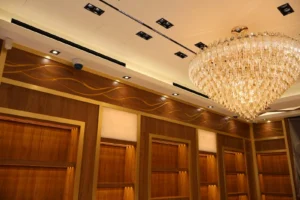
Showcases are usually the largest and slowest single item, so they’re made while approvals run. Site works follow the permits: partitions, ceilings, electrical, AC adjustments and the conduit for security cabling. Your SIRA-licensed installer then fits and commissions the system. In malls, most work runs at night under the landlord’s rules. See the 8-step turnkey jewellery fit-out process.
Step 7: Inspections and certificates
Before you can trade, you need three sign-offs:
- Civil defence completion
- The landlord’s inspection
- SIRA’s security audit, which your security consultant and installer arrange and which leads to the security system certificate
Keep copies in your handover pack.
Step 8: Compliance before the first sale
These sit outside the fit-out, but they must be in place before you trade. Confirm each with the authority named.
- Hallmarking: Gold sold by licensed retailers in Dubai must carry a hallmark approved by Dubai Central Laboratory (DCL), part of Dubai Municipality, under Federal Law No. 11 of 2015 on the trade in precious metals and stones.
- Anti-money-laundering: Dealers in precious metals and stones are supervised by the Ministry of Economy and Tourism under Federal Decree-Law No. 10 of 2025.
- Register: You must register on the goAML portal.
- Report: You must file a Dealers in Precious Metals and Stones Report (DPMSR) for transactions of AED 55,000 or more. That means cash transactions with individuals and any transaction with a company, including bank transfers.
- VAT: UAE VAT is 5%. Registration is mandatory for above AED 375,000 of taxable supplies in the previous 12 months and voluntary above AED 187,500.
- Maintenance and changes: SIRA requires an annual maintenance contract with a registered company and notification of any layout or component change, so plan any later refit with it in mind.
See compliance before your first sale: hallmarking, AML and VAT.
Step 9: Open and plan the next refit
Walk the shop with your fit-out team, sign the snag list, check your handover pack and open. If you plan seasonal trading around Diwali, DSF, Ramadan or Eid, book any refit 8 to 12 weeks before the busy period, not during it.
Where Paras Interiors fits
We’re a Dubai design and fit-out company that works on jewellery shops. We handle stages 4 to 7, the shop itself:
- Layout and design
- Showcases made in our own workshop
- The DCD, DEWA, DMCC and Dubai Municipality approvals
- Site works
- Handover
We don’t issue licences or register tenancies. You arrange those, usually through a business setup company. We also don’t prepare security plans or apply for SIRA approvals. A SIRA-approved security consultant that you appoint does that, and we build the shop to their approved plan.
Setup checklist
Download our jewellery business setup checklist: licence, tenancy, security, approvals, fit-out and compliance in one printable list.
Ready to plan your shop?
Book a free fit-out planning call or see our retail and jewellery shop fit-out.
Frequently Asked Questions
Yes. A DMCC free-zone company can be 100% foreign-owned. On the mainland, 100% foreign ownership is allowed for activities on DET’s full-foreign-ownership list, which includes jewellery trading. Check the current list for your exact activity, and confirm with DET or your free zone before you choose a structure.
You need a valid licence and tenancy for the approvals, and the security plan certificate needs your trade licence, so the licence comes first. Design can start earlier.
Yes. Gold and jewellery shops are a vital sector under Dubai Law No. 12 of 2016, so the security plan and the installed system must be certified by SIRA before you trade.
It depends on the licence route, the unit and how custom the showcases are. Ask each adviser and your fit-out company for a written step-by-step programme with owners and durations, and plan backwards from your opening date.
Three teams share it:
- A business setup company handles the licence.
- A SIRA-approved security consultant handles the security plan and SIRA approvals.
- Your fit-out company designs and builds the shop and handles the DCD, DEWA, DMCC and Dubai Municipality approvals.
Bring all three in early so the dates line up.