If you own or are buying an apartment in Dubai Marina, you have probably already searched for a straight answer on what renovation actually costs here. Most of what comes up online treats Marina as just another line in a citywide pricing table. That is a mistake. Marina is not JVC. It is not downtown. It is a waterfront, high-rise community of more than 200 towers with its own building management rules, its own goods lift booking systems, its own approval timelines, and a rental market that behaves very differently from the rest of Dubai.
This guide was written specifically for Marina apartment owners, investors, and overseas buyers who want real numbers, real tower-level detail, and honest answers to the questions that actually come up once you start planning a renovation here. We have already covered Dubai-wide pricing in detail in our guides on interior design cost per square foot in Dubai and our complete 2026 interior design pricing guide. This page goes deeper into what makes Dubai Marina different, because it genuinely is.
What Makes Dubai Marina Pricing Different From Other Dubai Communities
Three things separate Marina from almost everywhere else in Dubai when it comes to renovation cost and process.
The first is building logistics. Every Marina tower has its own management company, its own goods lift booking system, and its own approval requirements. There is no single standard process across the community the way there might be in a newer, single-developer community like Dubai Hills or Arabian Ranches.
The second is the view itself. Marina apartments are built around floor-to-ceiling glazing that frames the waterfront, and that glazing brings real design and cost implications around solar heat gain, glare, and cooling that a villa in a different part of Dubai simply does not face in the same way.
The third is the rental market. Marina has one of the highest concentrations of both long-term tenants and short-term holiday home guests anywhere in Dubai, which means the renovation decisions you make here have a direct, measurable effect on what your apartment earns, not just how it looks.
Our team at Paras Interiors works across Marina regularly through our dedicated interior design Dubai Marina service, and everything in this guide reflects what we see on the ground in towers across the community.
Does Renovating Your Marina Apartment Actually Pay for Itself in Higher Rent?
This is the question every Marina owner should be asking before they spend a single dirham, and it is the one almost nobody answers with real numbers.
A renovated apartment in Marina typically commands somewhere between 8 and 15 per cent higher rent than an unrenovated unit in the same tower. Marina apartments already deliver gross rental yields in the region of 5 to 7 per cent for long-term lets, so a thoughtful renovation does not just make the space nicer to live in, it improves the return on the asset itself.
Here is what that looks like with real figures. Say you spend AED 90,000 renovating a one-bedroom apartment that currently rents for AED 95,000 a year. An 8 to 15 per cent rent increase on that base figure works out to an extra AED 7,600 to AED 14,250 in annual rent. Over a five-year hold, that is AED 38,000 to AED 71,250 in additional income against a one-time renovation spend of AED 90,000. The renovation effectively pays for a meaningful share of itself through rent alone, before you even factor in the higher resale or re-let value of a well-finished unit when it is time to sell or change tenants.
For short-term rental owners the numbers are even more pronounced, which we cover in detail further down this guide and in our dedicated article on Airbnb interior design in Dubai.
The honest takeaway here is that a marina renovation should be evaluated the same way you would evaluate any other property investment decision, by comparing what you put in against what you get back, not purely as a cosmetic expense.
2026 Marina Apartment Renovation Cost by Unit Size
Pricing in Marina generally falls within the AED 130 to AED 450 per square foot range we have documented across our citywide interior design cost per square foot research, though Marina sits toward the middle and upper end of that range because of its premium positioning and the logistics costs that come with high-rise living.
| Unit Type | Typical Size | Economy Tier | Mid-Range Tier | Luxury Tier |
| Studio | 450 to 550 sqft | AED 45,000 to 82,500 | AED 82,500 to 151,250 | AED 151,250 to 220,000 |
| 1 Bedroom | 750 to 900 sqft | AED 75,000 to 135,000 | AED 135,000 to 247,500 | AED 247,500 to 360,000 |
| 2 Bedroom | 1,100 to 1,400 sqft | AED 110,000 to 210,000 | AED 210,000 to 385,000 | AED 385,000 to 560,000 |
| 3 Bedroom | 1,600 to 2,200 sqft | AED 160,000 to 330,000 | AED 330,000 to 605,000 | AED 605,000 to 880,000 |
| Penthouse | 2,500 sqft and above | AED 250,000 to 500,000+ | AED 500,000 to 925,000+ | AED 925,000 to 1,500,000+ |
These figures cover design fees, materials, labour, and standard fit-out work. They do not yet include the marina-specific costs we walk through later in this guide, things like building deposits, goods lift fees, and elevated service charges, so treat this table as your construction and design budget, not your total project cost.
The economy tier suits investors prioritising durability and a clean, functional finish for long-term rental. The mid-range tier is where most owner-occupiers and quality-focused landlords land, and it is also the tier that best supports the rent uplift numbers discussed above. The luxury tier suits owners in the higher-end Marina towers, where buyers and tenants expect a finish that matches the building’s positioning.
Do Specific Marina Towers Have Different Renovation Rules?
Yes, and this is one of the most overlooked parts of planning a marina renovation. With more than 200 towers in the community, each one has its own building management company, its own approval process, and its own quirks around things like goods lift booking windows, permitted working hours, and how quickly NOCs get processed.
Through our project history across the community, our Dubai Marina team has worked in towers including Princess Tower, Cayan Tower, Marina Gate, Marina Crown, Torch Tower, Silverene Towers, Damac Heights, Marina Pinnacle, JBR Residences, Sulafa Tower, and Al Majara, among many others across the district.
What we have learned from working across so many of these buildings is that the differences are real and worth knowing before you commit to a timeline. Some towers have a single, narrow goods lift booking window each day, which can extend a project by a week or more if your contractor does not plan around it from day one. Others have stricter noise curfews that limit working hours more tightly than DM’s general guidelines. Some buildings have well-organised, responsive management offices that turn around NOC approvals in days, while others can take two to three weeks for the same paperwork.
The practical advice here is simple. Before you finalise a renovation timeline, ask your designer or contractor whether they have direct project experience in your specific tower. A contractor who has already worked in your building knows the goods lift schedule, knows the management contact, and knows exactly what documentation that particular building expects, which removes a significant amount of uncertainty from your project before it even starts.
How Does District Cooling Affect Your Renovation Design and Costs?
Most towers in Dubai Marina run on district cooling, which means your apartment is connected to a centralised chilled water system rather than having its own standalone air conditioning condenser. This is billed separately from DEWA through a chiller fee, and it has real implications for how your renovation should be designed.
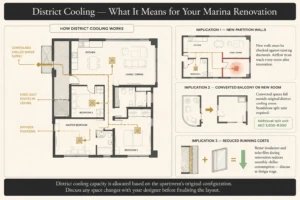
District cooling affects your layout decisions because the cooled air is delivered through a fixed network of ducts and diffusers that were designed around the apartment’s original floor plan. If you are moving or adding partition walls as part of your renovation, your designer needs to check that airflow still reaches every room properly afterward. A bedroom converted from what used to be an open-plan living space, for example, may end up undercooled or overcooled if the original ductwork was not designed with that wall in place.
It also affects whether you need supplementary cooling. If you are converting a balcony into enclosed living space or adding a room that falls outside the original ducted zones, you will likely need a standalone split unit for that space, since district cooling capacity is typically allocated based on the apartment’s original configuration.
On the cost side, district cooling means your monthly running costs after renovation are tied to your chiller consumption rather than a standard DEWA AC bill. Better insulation choices during your renovation, particularly around glazing and any newly enclosed spaces, can meaningfully reduce your ongoing chiller fee, which is worth discussing with your designer at the planning stage rather than after the fact.
What Is the Real Timeline for a Marina Apartment Renovation?
A realistic Marina renovation timeline needs to separate the approval wait from the actual construction time, because the two are very different things and both matter for planning purposes.
Design and drawings typically take 2 to 3 weeks, covering space planning, 3D visualisation, and material selection. Building management NOC approval and DM submission together usually take another 2 to 3 weeks, though this varies meaningfully by tower as discussed above. Procurement of materials and furniture generally takes 1 to 2 weeks once designs are finalised, particularly for any imported items. The physical fit out itself runs 6 to 10 weeks depending on the scope of the project. Snagging and final handover typically adds another week.
Added together, that gives a realistic total timeline of 12 to 19 weeks from the day you sign off on a design to the day you get your keys back, not the 6 to 10 week figure that some competitors quote when they are really only describing the construction phase.
This distinction matters most for Marina’s large population of overseas and remote investor owners, who need to plan flights, tenant handovers, or listing dates around an accurate end date, not an optimistic one. Our Dubai Marina interior design service gives written, guaranteed timelines by unit size for exactly this reason, because Marina’s overseas ownership base cannot afford vague estimates.
Renovating a Tenanted Marina Apartment
With more than 30,000 apartments across the Marina corridor and a large proportion of investor-owned units, renovating around an existing tenant is a common, everyday scenario, even though it is rarely addressed anywhere online.
If you want to renovate while your tenant remains in place, the starting point is the RERA notice requirements that apply to any works affecting a tenanted unit in Dubai. Depending on the scope of work and your tenancy contract terms, you will generally need to give appropriate written notice before any contractor accesses the property, and major works that significantly disrupt the tenant’s use of the apartment may require more formal arrangements under RERA’s rental dispute framework.
Partial renovation is often the most practical route for a tenanted unit. A bathroom refresh, a kitchen upgrade, or new flooring in specific rooms can frequently be scheduled and completed without requiring the tenant to vacate, particularly if the work is phased room by room. A full apartment renovation involving multiple trades working simultaneously is much harder to manage around an occupied unit and usually makes more sense to schedule at the point of tenant turnover.
Building management access rules also matter here. Most Marina towers require any contractor accessing an occupied unit to be registered with building security in advance, and goods lift bookings still apply in exactly the same way as they would for a vacant unit renovation. Coordinating this properly with both your tenant and your building management office is essential to avoid access disputes partway through a project.
If you are planning a renovation around a tenancy, the most efficient approach is usually to time the larger structural elements of the work for the period between tenancies, while using smaller, less disruptive upgrades to maintain and improve the unit during an active tenancy.
Does Building Age Affect Renovation Cost in Dubai Marina?
Yes, and this is one of the biggest unbudgeted surprises Marina owners run into partway through a project. Marina’s earliest towers were completed between 2006 and 2010, which means a meaningful share of the community’s buildings are now 16 to 20 years old, and that age genuinely changes what a renovation involves.
Older Marina towers were often built with copper plumbing runs that may need replacement or significant repair work during a bathroom or kitchen renovation, particularly if there has been any history of leaks or corrosion. Electrical distribution boards in buildings from this era were also designed around the load requirements of 2006 to 2010 living, which often fall short of what a modern apartment now demands once you add the additional appliances, smart home systems, and electronics that are standard in a 2026 renovation.
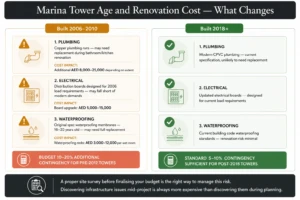
Original spec bathroom waterproofing is another common issue. Waterproofing membranes installed during initial construction have a finite lifespan, and a renovation that disturbs existing tiling in an older unit frequently uncovers waterproofing that needs to be redone properly rather than simply re-tiled over to avoid leaks into the unit below.
A 2018 or newer Marina Tower typically will not require this additional scope, since plumbing, electrical, and waterproofing standards from that period are closer to current building code requirements. As a practical guide, if you are renovating in one of Marina’s earlier towers, it is worth budgeting an additional 10 to 20 per cent contingency specifically to cover infrastructure-related surprises that only become visible once walls and floors are opened up.
The right way to manage this risk is a proper site survey before finalising your budget, rather than discovering these issues mid-project when contingency planning becomes far more expensive than contingency planning.
Designing a Marina Apartment for Airbnb and Holiday Home Use
Dubai Marina consistently ranks among the most searched neighbourhoods on Airbnb internationally, and short-term rental yields here can reach up to 20 per cent gross, well above the 5 to 7 per cent typical of long-term lets. This makes Marina one of the strongest short-term rental markets in the city, and it deserves its own design approach rather than being treated as an afterthought.
A short-term rental renovation in Marina differs from a standard residential renovation in several specific ways. Surfaces need to be durable and easy to clean given the high guest turnover, which means materials like quartz countertops, porcelain flooring, and washable wall finishes outperform softer, higher-maintenance materials in this context. Kitchen specifications need to meet Dubai’s Department of Tourism and higher-maintenance requirements for holiday home licensing, which includes specific equipment and safety provisions. Layouts benefit from fast turnaround thinking, with linen storage, cleaning supply access, and furniture that can be reset quickly between guests all factored into the design from the start.
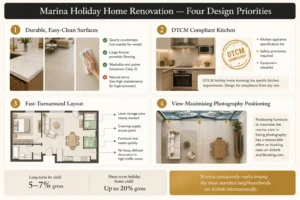
View-maximising furniture placement also matters more here than in a standard residential project, since listing photography genuinely drives booking rates on platforms like Airbnb and Booking.com. Positioning the main seating and dining areas to capture the marina view in photographs, and choosing furniture scaled appropriately to the room without blocking sightlines to the windows, has a measurable effect on how a listing performs.
We cover the full design strategy for short-term rental properties, including room-by-room guidance and current 2026 design trends for Dubai holiday homes, in our dedicated guide on Airbnb interior design in Dubai, which is worth reading alongside this guide if you are renovating specifically for the short-term rental market.
How Floor-to-Ceiling Marina Windows Affect Comfort and Design
Marina’s signature floor-to-ceiling glazing is one of the community’s biggest selling points, but it also creates a genuine thermal challenge that needs addressing during any renovation. Large expanses of unshaded glass facing the water bring significant solar heat gain into the apartment, particularly on west- and south-facing units, which drives up cooling bills and can create uncomfortably hot zones near the windows during peak sun hours.
There are several practical, design-led solutions that solve this without sacrificing the view that makes Marina apartments so desirable in the first place. Solar control window film is one of the most cost-effective interventions, reducing heat transmission through the glass while remaining virtually invisible, and it typically pays for itself through reduced chiller fees over a few years. Motorised blackout and sheer curtain combinations give you flexible control, allowing full light and view during cooler parts of the day while providing shade and privacy when the sun is at its most intense. Heat-resistant flooring near the glazing line, such as porcelain rather than natural timber, prevents the surface temperature issues that softer materials can develop in direct, prolonged sun exposure.
The goal with any of these solutions is comfort without compromise. A well-designed Marina apartment should let you enjoy the view at any hour of the day without dealing with glare on a television screen in the afternoon or a noticeably warmer room near the windows by early evening. Our design team factors this into every Marina project from the earliest planning stage, because in a community where the view is the entire point of the address, the solution has to work with the glazing, not against it.
Dubai Marina vs JBR: Are the Rules Actually Different?
Marina and JBR sit right next to each other geographically, and they are often grouped together as a single area in marketing material, but they are genuinely distinct master communities with different management structures, and the rules that apply to your renovation can differ meaningfully depending on which side of the boundary your building sits.
Dubai Marina’s residential towers are generally managed under the Jumeirah Lake Towers Authority framework alongside individual building management companies, with NOC and approval processes handled accordingly. JBR, by contrast, falls under Jumeirah Beach Residences Management, which operates its own distinct set of building rules, approval processes, and goods lift systems separate from Marina’s towers. JBR also has a more tourism- and retail-driven ground floor mix along The Walk, compared to Marina’s more residentially focused tower base, which can influence noise curfews and contractor access hours in some buildings.
For an owner near the boundary between the two communities, the practical takeaway is to confirm with your specific building’s management office which authority and approval process actually applies to your unit, rather than assuming the rules are identical simply because the two communities are next door to each other and often discussed together. Our team handles approvals across both communities regularly and can confirm the specific process for your building as part of an initial consultation.
Hidden Costs Beyond the Fit Out Quote
A fit-out quote covers design, materials, and labour, but it rarely covers every cost you will actually encounter during a marina apartment renovation. Knowing about these in advance prevents budget surprises partway through your project.
Building management security and damage deposits are required by most Marina towers before any renovation work begins, typically refundable and usually falling somewhere between AED 5,000 and AED 20,000, depending on the building and the scope of your project. Goods lift booking fees are charged by many towers for the use of the service elevator during material delivery and waste removal, and these vary by building rather than following a fixed citywide rate. Contractor access passes are another building level requirement in most towers, often involving a small per-contractor fee to register workers with building security for the duration of the project.
Service charges are also worth understanding in the context of a renovation, since Marina’s elevated service charges, typically in the range of AED 10 to 15 per square foot annually, are partly tied to building-wide cooling and maintenance costs. Renovation choices around insulation and glazing, discussed earlier in this guide, can in some cases help reduce your individual unit’s chiller consumption, even though the building-wide service charge itself is set independently.
A genuinely complete Marina renovation budget should account for your fit-out quote plus an allowance for these building-level costs, which together can add anywhere from AED 10,000 to AED 40,000 or more to your total project cost depending on the building and scope. Asking your designer or contractor for a full picture of these costs before you begin, not just the construction quote, is one of the simplest ways to avoid an unpleasant surprise midway through your project.
Getting an Accurate Quote for Your Marina Apartment
Every figure in this guide is a genuine, real market benchmark, but the only reliable budget for your specific apartment comes from an actual site visit and a detailed assessment of your unit, your building, and your goals for the space.
At Paras Interiors, our Dubai Marina interior design service begins with a free consultation and view assessment at your apartment, anywhere in the Marina, followed by photorealistic 3D visualization so you can see exactly how your finished space will look before any work begins. Every quote we provide is a fixed, line-by-line breakdown agreed to before construction starts, with no surprise increases at handover, a commitment we have maintained across more than 150 projects throughout the UAE.
We manage building management NOCs, goods lift bookings, and all required approvals directly, and because we have worked across so many of Marina’s towers, including Princess Tower, Cayan Tower, Marina Gate, Torch Tower, Damac Heights, and many others, we already understand the specific requirements of most buildings in the community before your project even begins.
If you live overseas, we also manage the entire process remotely, with 3D design approvals over video calls, daily photo and video progress updates throughout the fit-out, and a final video walkthrough before you fly in for handover, which is how a significant share of our Marina clients manage their renovation from outside the UAE.
To explore our broader work across residential, office, and commercial projects, visit our services overview or browse our project gallery. You can also read more about our background and approach on our about us page.
Frequently Asked Questions
Yes. A renovated Marina apartment typically commands 8 to 15 percent higher rent than an unrenovated unit in the same tower, on top of Marina’s existing 5 to 7 percent gross rental yield for long term lets. For a typical one bedroom renting at AED 95,000 a year, that translates to roughly AED 7,600 to AED 14,250 in additional annual rent following a well planned renovation.
Yes. Each of Marina’s 200 plus towers has its own building management company with its own NOC process, goods lift booking system, and working hour restrictions. Some buildings process approvals within days while others take two to three weeks, and some have stricter noise curfews or more limited goods lift availability than others. Confirming your specific building’s requirements before finalising a timeline is essential.
Most Marina towers run on district cooling billed separately from DEWA through a chiller fee. This affects where you can place new partition walls due to existing ductwork, whether converted rooms need supplementary split units, and your ongoing running costs after renovation, which can be reduced through better insulation and glazing choices made during the design stage.
A complete, realistic timeline including design and drawings, building management NOC and DM approval, procurement, fit out, and snagging runs 12 to 19 weeks for most apartments, not the 6 to 10 week figure that often only describes the construction phase alone.
Yes, with appropriate RERA notice and building management coordination. Partial renovations such as a bathroom or kitchen refresh can often be completed around an occupied tenancy, while larger, multi trade renovations are usually easier to schedule between tenancies.
Often yes. Towers built between 2006 and 2010 may have copper plumbing, dated electrical distribution boards, and original spec waterproofing that needs replacement during renovation, work that a 2018 or newer tower typically would not require. Budgeting an additional 10 to 20 percent contingency for older towers is a sensible precaution.
Short term rental renovations in Marina benefit from durable, easy to clean surfaces, DTCM compliant kitchen specifications, fast turnaround friendly layouts, and furniture positioned to maximise the marina view in listing photography. Marina’s short term rental yields can reach up to 20 percent gross, making this an increasingly popular renovation strategy in the community.
Solar control window film, motorised blackout and sheer curtain combinations, and heat resistant flooring near glazing all reduce solar heat gain and surface temperature issues without sacrificing the view, which remains the primary reason most owners choose a Marina address in the first place.
No. Marina towers generally fall under the Jumeirah Lake Towers Authority framework alongside individual building management, while JBR falls under Jumeirah Beach Residences Management with its own separate approval process. Always confirm with your specific building which framework applies to your unit.
Building security and damage deposits, typically AED 5,000 to AED 20,000 and usually refundable, goods lift booking fees, contractor access passes, and Marina’s elevated service charges of roughly AED 10 to 15 per square foot annually are all common additional costs that sit outside a standard fit out quote.