A contractor with ten years of fit-out experience in Dubai takes on a bathroom renovation in Sharjah. He submits documentation using the same format he uses for Dubai Municipality submissions. He schedules the works on a timeline built around Dubai’s typical approval turnaround. He does not obtain a specific NOC from the building developer because, in his Dubai experience, the project type does not require one.
Six weeks later, the project is stopped mid-execution. The Sharjah City Municipality has issued a violation notice. The client, who trusted the contractor’s experience and had no reason to question his permit workflow, is now facing fines, a mandated reinstatement of works already completed, and a project timeline that has doubled.
This is not a hypothetical. It is a pattern we encounter regularly when clients come to Paras Interiors after a cross-border project has gone wrong with a contractor who did not adjust their process for a different regulatory environment.
The core problem is information asymmetry. Dubai’s permit and approval framework for interior fit-out works is relatively well-documented; there are detailed guidance notes on the Dubai Municipality website, the process is discussed extensively in industry forums, and most experienced Dubai contractors have navigated it enough times to understand the requirements precisely. Sharjah and Ajman do not have the same depth of publicly available guidance. The processes exist, they are enforced, and they differ from Dubai’s in ways that matter practically, but the documentation of those differences is scattered, inconsistent, and often out of date.
This post maps those differences clearly. It covers the primary approval authority in each emirate, the submission requirements, the typical timeline, the NOC landscape, and the most common mistakes made by contractors who do not adjust their workflow when they cross an emirate boundary. It is written for property owners, investors, and tenants who are managing renovation or fit-out projects in one or more of these markets and want to understand what they are agreeing to before works begin.
Why This Matters More in the Northern Emirates
In Dubai, the gap between the regulatory framework and public awareness of that framework is relatively small. Most clients who have lived in Dubai for several years have at least a working knowledge of the fact that certain works require a permit, that the building NOC is a real requirement rather than a bureaucratic formality, and that Dubai Municipality is the relevant authority for most residential fit-out works. This baseline awareness is imperfect, but it exists.
In Sharjah and Ajman, this baseline is less established among the expatriate and investor community. Part of this is a documentation gap the municipality websites in both emirates are less detailed in their public-facing guidance for residential works than Dubai Municipality’s equivalent. Part of it is a contractor information gap Dubai-experienced contractors frequently work across the border without adjusting their process, which means clients receive Dubai-calibrated advice for a non-Dubai regulatory environment. And part of it is a property type difference, Sharjah and Ajman have a higher proportion of older residential stock and a more complex mixture of private developer, government housing, and freehold properties, each with different NOC requirements that do not map neatly onto Dubai’s framework.

The result is that permit-related project disruption is proportionally more common in cross-emirate projects, particularly Sharjah and Ajman, than in Dubai-only projects of comparable scope. This is not because the Northern Emirates’ frameworks are more onerous. In several respects, Ajman’s process is more straightforward than Dubai’s for certain project types. It is because the process is less well-understood, less well-prepared for, and less frequently discussed in the accessible industry content that contractors and clients rely on.
Understanding the specific requirements of each emirate before a project begins is not a bureaucratic exercise. It is the difference between a project that proceeds on schedule and one that gets stopped at the worst possible moment.
Dubai’s Approval Framework: The Baseline
Because Dubai is the market most readers will have existing familiarity with, and because it is the baseline against which Sharjah and Ajman are most usefully compared, this section summarizes the key structural features of Dubai’s permit framework without attempting to be comprehensive. Other posts on this site cover Dubai-specific compliance in more detail, including the DIFC-specific regulatory environment which operates under a distinct authority from Dubai Municipality.
Primary Authority: Dubai Municipality (DM)
Dubai Municipality’s Building Permit Department is the primary approval authority for residential and commercial interior fit-out works within Dubai’s jurisdiction. Works within free zones, DIFC, DAFZA, JAFZA, and Dubai Airport Free Zone, fall under the respective free zone authority rather than DM, which is a meaningful distinction for commercial clients operating across both jurisdictions.
What Requires a DM Permit
For residential properties, Dubai Municipality distinguishes between works that require a formal permit and works that can proceed with only a building management NOC:
NOC only (no DM permit required):
- Painting and surface decoration
- Flooring replacement (like-for-like, no structural subfloor modification)
- Kitchen and bathroom fixture replacement (same position, no plumbing rerouting)
- Soft furnishing and furniture installation
- Standard joinery installation (wardrobes, cabinetry, shelving not affecting structural elements)
DM permit required:
- Internal partition modification or removal
- Any works affecting the building’s structural elements
- MEP modifications (electrical circuit additions, plumbing rerouting, HVAC alterations)
- Changes to wet area layouts that require slab penetration
- Addition of mezzanine levels or raised platforms affecting floor-to-ceiling height
For commercial fit-out, the permit threshold is lower virtually any works beyond surface decoration in a commercial tenancy require a DM permit submission with approved engineering drawings.
Typical Timeline
- NOC from building management: Three to ten working days in most Dubai residential buildings.
- DM permit for residential works (where required): Three to six weeks from complete submission, assuming no drawing revisions requested.
- DM permit for commercial fit-out: Four to eight weeks from complete submission.
The NOC Landscape in Dubai
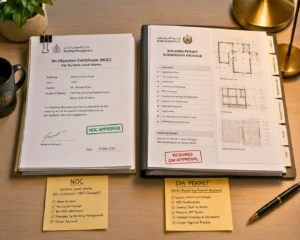
Dubai’s building NOC process is relatively standardized across major residential developments. Most buildings managed by Emaar, Nakheel, Dubai Properties, or professional building management companies have a defined NOC application process with documented requirements and predictable turnaround times. Older buildings with less formal management structures can be less predictable, but the process exists and is understood by experienced Dubai contractors.
Sharjah’s Approval Framework
Sharjah’s regulatory environment for interior fit-out works is administered primarily by the Sharjah City Municipality (SCM), with the Sharjah Planning and Survey Department involved in specific categories of works. Understanding which works fall under which authority, and what the submission requirements are for each, is the foundational requirement for any Sharjah project.
Our interior design services in Sharjah cover both residential and commercial projects across the emirate, and the permit management below is integrated into how we structure every Sharjah project from the outset.
Primary Authority: Sharjah City Municipality
For residential interior works in Sharjah, the Sharjah City Municipality (SCM) is the primary authority. Unlike Dubai Municipality’s relatively clear distinction between permit-required and NOC-only works, Sharjah’s framework applies permit requirements to a broader category of residential works. Specifically:
Works requiring SCM permit approval in Sharjah:
- Any modification to internal partitions, whether removal or addition
- Bathroom and kitchen layout changes, including fixture repositioning within an existing wet area
- Any works affecting the building’s MEP systems, electrical modifications, plumbing rerouting, HVAC changes
- External facade modifications (relevant for villas and ground-floor units with external elements)
- Changes to window or door openings
- Mezzanine addition or any modification affecting ceiling height or floor slab
Works typically proceed with NOC only:
- Surface decoration (painting, wallpaper)
- Flooring replacement without subfloor modification
- Kitchen and bathroom fixture replacement in existing positions without plumbing rerouting
- Non-structural joinery installation
The practical difference from Dubai is that Sharjah applies its permit requirement to a broader interpretation of what constitutes a layout modification. In Dubai, a like-for-like fixture replacement in a bathroom that does not involve replumbing typically proceeds without a permit. In Sharjah, the determination of whether a permit is required can depend on the building type, the age of the building, and the specific interpretation applied by the inspector assigned to the project which means conservative submission (applying for a permit when in doubt) is the more reliable approach.
Submission Requirements
SCM permit submissions for residential fit-out works typically require:
- Architectural drawings (floor plan, existing and proposed, at a minimum of 1:100 scale)
- MEP drawings if any MEP works are included in scope
- Structural drawings if any structural modifications are involved
- Copies of the property ownership documentation or a valid tenancy contract
- NOC from the building developer or landlord (in addition to, not instead of, the municipality permit)
- Contractor trade license details and, for specific project types, a registered engineer’s signature on the drawings
The requirement for a registered engineer’s signature on submissions, even for works that in Dubai might be submitted by an interior design firm without engineering sign-off, is a Sharjah-specific requirement that catches Dubai-experienced contractors consistently. Submissions without the appropriate engineer signatory are rejected at the intake stage, not after review, which means the timeline resets to zero and the project waits for a compliant resubmission.
Inspection Stages
Sharjah City Municipality’s inspection process for residential fit-out works includes an initial pre-works inspection (confirming the existing condition before works commence), a mid-works inspection for projects involving structural or MEP modifications, and a completion inspection before the fit-out can be formally closed. The mid-works inspection requirement is not standard across all project types in Dubai, and contractors unfamiliar with the Sharjah process sometimes proceed past the mid-works inspection trigger point without requesting the inspection, creating a compliance gap that becomes a problem at the completion stage.
Typical Timeline
SCM permit for residential fit-out: Four to eight weeks from complete, compliant submission. Incomplete submissions, most commonly due to missing engineer signatory or inadequate drawing detail, reset the clock, which in practice means that projects that submit incorrectly can face twelve to fourteen weeks of approval time before work commences.
NOC from building developer or landlord in Sharjah: This varies considerably. Private developer communities (those under developers like Arada, Alef Group, or Sharjah-based master developers) have structured NOC processes with documented turnaround times, typically five to fifteen working days. Properties in older Sharjah building stock with less formal ownership structures can have significantly less predictable NOC timelines.
Government Housing and Sharjah Housing Authority Properties
A significant proportion of Sharjah’s residential stock consists of properties under the Sharjah Housing Authority (SHA) or comparable government housing programs. These properties require SHA approval in addition to SCM municipality permits, and the SHA approval process runs on a separate timeline from the SCM permit, typically four to six weeks from SHA application, which may run sequentially rather than concurrently with the municipality process depending on the specific works category.

For clients renovating SHA-managed properties, the practical implication is a longer pre-works phase than for private developer properties and a more conservative approach to scope, SHA approval is less predictable for works that fall into grey-area categories than SCM municipality approval is.
Ajman’s Approval Framework
Ajman’s approval framework is administered by the Ajman Municipality and Planning Department (AMPD), and it is in some respects the most distinct of the three markets covered in this post both in the structure of the approval process and in the practical dynamics of working with a smaller authority that handles a much lower volume of commercial fit-out submissions than Dubai Municipality or Sharjah City Municipality.
Our interior design services in Ajman reflect the specific regulatory environment of the emirate, including the permit management considerations below.
Primary Authority: Ajman Municipality and Planning Department
AMPD is the single primary authority for both residential and commercial interior fit-out permits in Ajman. Unlike Dubai’s structure, where free zones operate under separate authority, Ajman’s jurisdiction applies relatively uniformly across the emirate’s residential and commercial stock, with the exception of Ajman Free Zone, which operates under AFZA’s own regulations for tenant fit-out.
What Requires an AMPD Permit
Ajman’s permit framework for residential works is similar in structure to Sharjah’s but applies with somewhat more consistency in its interpretation partly because AMPD handles a smaller volume of submissions than SCM and partly because the authority has invested in clarifying its residential permit requirements over the past several years.
Works requiring AMPD permit:
- Internal partition modification (addition or removal)
- Any MEP works beyond like-for-like fixture replacement
- Structural modifications
- Changes to the building envelope (relevant for villas and townhouses)
- Addition of built-in furniture or joinery that requires building integration (not freestanding furniture)
- Any works in common areas of apartment buildings
Works typically proceed with the landlord/owner NOC only:
- Surface redecoration (painting, wallpaper)
- Flooring replacement (like-for-like, no structural subfloor modification)
- Freestanding furniture installation
- Kitchen appliance replacement in existing positions
The Submission Dynamic in Ajman
One practically significant difference between AMPD and the Dubai and Sharjah authorities is the submission dynamic that results from a smaller, more accessible department. AMPD handles significantly fewer commercial and residential permit submissions than DM or SCM, which has two effects that work in opposite directions.
On the positive side: Pre-submission consultation with AMPD staff is more accessible than in larger authorities. For projects in genuinely unclear categories where it is not obvious whether a permit is required or what the correct submission format is, a direct preliminary discussion with the authority can provide clarity that in Dubai would require a formal pre-application meeting or simply the submission itself followed by the authority’s response.
On the less predictable side: AMPD’s processes have historically been less codified in publicly available documentation than DM’s, and the specific requirements for drawing format, scale, and supporting documentation can vary based on the reviewer assigned to the submission. This is not unique to AMPD; it is a characteristic of smaller municipal authorities generally, but it means that contractors without first-hand AMPD submission experience may receive different guidance from different touchpoints within the authority, creating confusion that would not occur in a more systematized, larger authority.
The mitigation for this variability is simple: submit complete, overdocumented packages rather than minimum-compliant packages. A submission that includes more supporting documentation than the authority strictly requires is rarely penalized. A submission that omits documentation that a specific reviewer considers necessary is returned for resubmission, with the associated timeline reset.
Typical Timeline
AMPD permit for residential fit-out: Three to six weeks from complete, compliant submission. Ajman’s smaller submission volume means that permits for straightforward residential projects sometimes process faster than comparable submissions in Dubai or Sharjah, particularly for works with clear precedent in the authority’s recent approval history.
NOC from building management in Ajman: Highly variable. Ajman has a mixture of private developer properties, older privately owned stock, and government-affiliated housing where the NOC source and process differ considerably. Private developer communities (Cityscape, Al Zorah, and similar) have structured NOC processes. Older privately owned apartment buildings may require a direct approach to the property owner rather than a formal management company, which is less predictable.
Ajman Freehold Market Considerations

Ajman was one of the first UAE emirates to open freehold property ownership to non-GCC nationals, which has resulted in a residential investment market with a high proportion of foreign investor-owners managing properties remotely. This creates a specific permit dynamic: the property owner who needs to sign NOC applications or permit submissions may be located outside the UAE, requiring apostilled power-of-attorney documentation for their local representative to execute on their behalf. This is a standard requirement but one that needs to be anticipated and arranged before the permit process begins, leaving it until the submission stage adds weeks to the pre-works phase.
Practical Comparison: All Three Emirates Side by Side
| Variable | Dubai | Sharjah | Ajman |
| Primary authority (residential) | Dubai Municipality (DM) | Sharjah City Municipality (SCM) | Ajman Municipality and Planning Department (AMPD) |
| Secondary authority where applicable | DCD (certain commercial/high-rise) free zone authorities | Sharjah Planning and Survey Dept (specific categories), Sharjah Housing Authority (SHA properties) | Ajman Free Zone Authority (AFZA) for free zone tenancies |
| Permit required for partition modification | Yes | Yes | Yes |
| Permit required for like-for-like fixture replacement | No (NOC only) | Sometimes (depends on building age and inspector interpretation) | No (NOC only for straightforward replacements) |
| Permit required for MEP modifications | Yes | Yes | Yes |
| Engineer signatory required on drawings | For structural/MEP works | Yes, broadly required across most permit categories | For structural/MEP works; less consistently required for simpler categories |
| Inspection stages (residential) | Completion inspection (structural/MEP mid-works inspection for complex projects) | Pre-works, mid-works (for MEP/structural), completion | Pre-works (for complex projects), completion |
| Typical permit timeline (complete submission) | 3 to 6 weeks | 4 to 8 weeks | 3 to 6 weeks |
| Government housing additional approval | Limited (DHCOG for specific communities) | Yes, SHA approval required for SHA properties | Limited, specific older government stock only |
| Building NOC: process predictability | High (major developers have standardised processes) | Medium (varies significantly by developer type and building age) | Low to medium (highly variable; some buildings require direct owner contact) |
| Submission format | DM online portal (Ejari-integrated for residential) | Physical and online submission; specific format requirements | AMPD office submission; online portal for some categories |
| Remote investor considerations | POA accepted; apostille required for non-UAE signatories | POA accepted; apostille required | POA accepted; apostille required; more common requirement due to investor-owner profile |
| Consequences of non-compliant works | Stop-work notice, fines, reinstatement order | Stop-work notice, fines, reinstatement order, potential escalation to Sharjah Courts | Stop-work notice, fines, reinstatement order |
Common Cross-Emirate Mistakes: What Goes Wrong
The table above maps the structural differences clearly. What it does not capture is what those differences look like in practice when a project runs into the gaps. These are the most common failure patterns we see in cross-emirate projects where the contractor or client has not adjusted their approach for the specific emirate.
Assuming the Same Works Threshold Applies
The most common mistake, and the one with the most direct consequences, is a Dubai-experienced contractor applying Dubai’s permit threshold to a Sharjah or Ajman project. Specifically, assuming that a bathroom renovation that involved only fixture repositioning within the existing wet area footprint did not require a permit because it would not require one in Dubai. In Sharjah, that determination depends on whether the repositioning involved any MEP adjustment, which it almost always does when sanitary ware is moved, and whether the building’s age and type place it in a category where SCM applies a broader interpretation of what constitutes a layout modification.
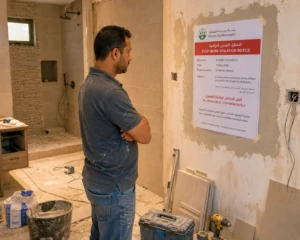
The consequence is works commenced without a permit, discovered at SCM inspection, and a stop-work notice was issued. The reinstatement requirement, in the worst cases, restoring the works to their pre-commencement condition before the proper permit application can proceed, is both expensive and time-consuming. The reinstatement cost is borne by the client, not the contractor, in most standard fit-out contracts unless the contractor has specifically warranted that they would manage permit compliance.
Submitting Without the Required Engineer Signatory in Sharjah
Sharjah’s requirement for a registered engineer’s signature on permit submissions even for works that in Dubai might not require engineering sign-off is consistently underestimated. The most common manifestation is a submission package prepared by an interior design firm to Dubai Municipality standards (which includes architectural drawings but not necessarily structural or MEP drawings signed by a registered engineer) submitted to SCM and rejected at intake. The submission is not reviewed and returned with comments it is simply rejected for non-compliance with submission requirements, and the process resets.
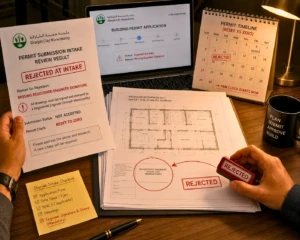
A four-week permit target becomes an eight- to ten-week wait when the first submission is rejected and the second requires sourcing an additional registered engineer signatory, revising the drawings to engineering specifications, and resubmitting.
Treating the Ajman NOC Process as Equivalent to Dubai
In Dubai’s major residential developments, the building NOC process is managed by a professional building management company with a defined application form, a standard checklist, and a predictable response time. Contractors experienced in Dubai factor in a one-to-two-week NOC window and move forward on that basis.

In Ajman’s older residential stock, the equivalent process may require identifying the actual property owner; confirming whether a management company exists or whether the owner manages the building directly; determining whether the owner is a resident in the UAE or based overseas (which triggers the POA/apostille requirement); and then negotiating a NOC that may not follow a standard format because the owner has never issued one before.
This process routinely takes three to five weeks in Ajman’s older buildings, sometimes longer, and it must be completed before AMPD permits can be submitted in most cases. A project that plans a two-week NOC window and an immediate permit submission is already four to six weeks behind its planned start date before the permit application is even submitted.
Not Anticipating the Mid-Works Inspection in Sharjah
Sharjah’s requirement for a mid-works inspection before structural or MEP works are closed in, plastered over, tiled, or otherwise concealed is straightforward in principle but consistently overlooked in practice by contractors whose Dubai experience does not include this inspection stage for comparable works.
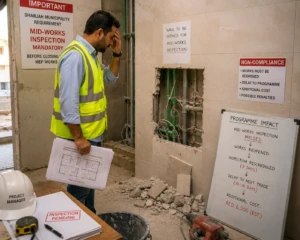
A contractor who closes in MEP works before the SCM mid-works inspection has taken place has created a situation where the inspection cannot be completed without opening the works back up. The SCM inspector’s visit, the remediation, the reinstatement, and the rescheduled inspection collectively add three to six weeks to the project. The client’s living or working in a partially complete fit-out in the interim is an additional cost, in the literal sense of temporary accommodation or business disruption, that is not included in any contractor quote.
How Paras Interiors Manages Cross-Emirate Approvals
The reason cross-emirate permit management sits within Paras Interiors’ scope, rather than being delegated to a client-managed process or a separate permit expeditor, is that permit compliance is not separate from design and delivery. The drawings that go to the municipality must reflect the design accurately and completely. The inspection sequencing must align with the construction program. The NOC requirements must be confirmed before the site commencement date is set, not after.

A firm that handles design but leaves permit management to the client, or that subcontracts permit management to a separate party who was not involved in the design, creates a coordination gap that produces exactly the failure patterns described above, not because anyone is incompetent, but because the information transfer between separated parties is imperfect and the timeline dependencies between design sign-off, permit submission, and works commencement are compressed in ways that allow errors to compound quickly.
Paras Interiors’ home interior design services and office interior design services both integrate permit management as part of the project scope from the outset. This means:
The design is drawn to the submission standard of the specific emirate’s authority from the first documented draft, not adapted after the fact to match a municipality’s requirements. Sharjah submissions are prepared to SCM standards, including the registered engineer signatory requirement, as part of the standard design documentation package. Ajman submissions are prepared to AMPD standards with the over-documentation approach that minimizes the risk of intake rejection.
The NOC process is initiated at the earliest point in the project timeline at which the scope is sufficiently defined, typically during the concept development phase rather than after design sign-off. For Ajman projects with complex owner structures, the POA requirements are identified in the first consultation, and the client is briefed on what they need to arrange before the permit timeline begins.
Inspection scheduling is built into the construction program, not treated as a separate administrative event that will be coordinated whenever the inspector is available. The mid-works inspection requirement in Sharjah is planned into the program explicitly, with MEP works scheduled to reach the inspection-ready state approximately one week before the inspection is booked, creating a buffer for the inspection visit without holding the program.
The client receives a single point of accountability for design, permit management, contractor coordination, and delivery, which means that when the SCM inspector raises a query on a submission drawing, the response comes from the same team that produced the drawing, not from a separate consultant who needs to be briefed on what the drawing means and why it was specified that way.
This single-point accountability is the practical argument for working with a firm that operates across Dubai, Sharjah, and Ajman as genuine active markets, not as occasional extensions from a Dubai-only base. The difference is not in the willingness to take on cross-emirate projects. It is in the first-hand, current-cycle knowledge of what each authority actually requires at the submission stage, which can only be maintained through regular active projects in each market.
You can see completed projects across the UAE to understand the range of work we deliver across these markets, and if you have a project in Sharjah, Ajman, or across multiple emirates, contact us to discuss the specific brief and permit requirements before the timeline pressure begins.
Paras Interiors maintains active project portfolios in Dubai, Sharjah, and Ajman as ongoing markets, not occasional extensions. If you have a project that spans multiple emirates, a commercial client with offices in Dubai and Sharjah, an investor with apartments in Dubai Marina and Ajman, or a family relocating from Dubai to a Sharjah villa, the permit management across those separate jurisdictions is handled within the same team and the same accountable project scope. Contact us to discuss the specifics of your cross-emirate brief.
Frequently Asked Questions
Yes. Each emirate has its own approval authorities, permit processes, documentation requirements, and timelines. While the overall goal is to ensure safety and regulatory compliance, the approval workflow and required NOCs can vary significantly between Dubai, Sharjah, and Ajman.
Most renovation, fit-out, and structural modification projects require permits or approvals, especially if they involve partitions, MEP work, fire safety systems, or commercial spaces. Even residential projects may require building management or municipality approvals depending on the scope of work.
Dubai generally has the most layered approval system because projects may require approvals from multiple authorities such as Dubai Municipality, Civil Defence, DEWA, free-zone authorities, or community developers depending on the property’s location and type.
Yes. Many fit-out and interior projects in Sharjah require approvals from the relevant authorities, including Civil Defence approvals for fire and life-safety compliance depending on the project type and usage.
Yes. Commercial spaces such as restaurants, retail stores, clinics, offices, gyms, and hospitality projects typically require additional approvals related to fire safety, health regulations, utilities, and operational licensing compared to residential interiors.
No. Starting work before obtaining the required permits can lead to project delays, fines, rejection of approvals, or requirements to remove unapproved work. It’s always advisable to secure approvals before beginning construction or fit-out activities.
Approval timelines vary by emirate, project complexity, and the authorities involved. Simple projects may be approved within days, while larger renovations or commercial fit-outs requiring multiple NOCs can take several weeks.