Dubai’s cafe scene has matured dramatically. Walk through DIFC at 8 AM, stroll Alserkal Avenue on a Friday afternoon, or step into any of the new specialty coffee spots in Jumeirah or Business Bay, and you will immediately sense that a coffee and a chair are no longer enough. Your guests are choosing cafes the way they choose hotels: by atmosphere, by story, by how the space makes them feel the moment they step inside.
As designers who have transformed F&B spaces across Dubai, Sharjah, and Abu Dhabi, we have seen a consistent pattern: cafes that invest intelligently in interior design from day one outperform those that retrofit it later in dwell time, in average spend per visit, and in the one metric no one talks about openly but every F&B owner watches closely, which is return footfall rate.
This guide does not recycle generic design advice. It is built for UAE cafe owners, investors, and F&B entrepreneurs navigating a market with very specific demands. That includes Dubai Municipality fit-out compliance, designing for a guest mix that spans 200 nationalities, the realities of 45°C summers, and the shifting rhythm of Ramadan trading hours.
Why Cafe Interior Design in Dubai Is a Different Game
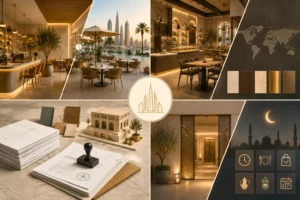
The global cafe design playbook covering Scandinavian minimalism, exposed brick, and Edison bulbs has been thoroughly absorbed and replicated in Dubai. What is scarce is originality rooted in local context.
Here is what makes the UAE market distinct from every other hospitality market in the world.
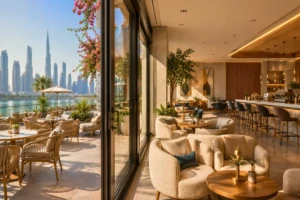
The climate factor is non-negotiable. Unlike European or Asian markets where pavement terraces drive revenue for eight months a year, Dubai’s outdoor season runs roughly from October to April. Your interior has to carry the full weight of the guest experience for the remaining months. A terrace-heavy concept with an underwhelming interior is effectively a seasonal business in a market that runs year-round.
The competition is international by default. Dubai guests frequently travel to London, Tokyo, and New York. They have seen design. Mediocre fit-outs are recognised instantly and rarely forgiven. To understand the broader landscape of what design approaches are working in Dubai right now, it is worth studying the trends shaping the market before you brief a designer.
The DM approval process shapes your brief. Dubai Municipality requires fit-out drawings, civil defense compliance, and NOC approvals before a single wall is touched. Designing without a contractor who understands this process adds months to your opening timeline, and those are months of rent paid on an empty shell.
Ramadan changes the operating model. If your cafe serves food, Ramadan trading involves restricted daytime operations, screened entrances, and modified signage. Many operators discover mid-fit-out that their layout does not accommodate the curtaining or partitioning required under Dubai Municipality Ramadan guidelines. Designing for this from the start costs a fraction of what it costs to retrofit.
Define Your Guest Before You Define Your Look
Every mistake in cafe interior design begins with aesthetics. Every successful cafe begins with a clear picture of who is actually sitting in those chairs.
In Dubai’s market, you are essentially choosing a lane. The major guest profiles and the design language each demands look roughly like this.
The remote worker and digital nomad are concentrated in areas like Business Bay, JLT, and JVC. This guest needs reliable power points, low ambient noise, strong WiFi signal, and surfaces wide enough for a laptop and a flat white. They stay between two and four hours and order two or three items. Your layout needs to support that dwell time without crowding out table-turning revenue during peak windows.
The weekend brunch crowd is high-energy and photo-driven, concentrated in Jumeirah, The Beach, and newer destinations like Bluewaters. This guest prioritises Instagrammable corners, natural-light-facing seating, and a visual identity distinctive enough to stand on its own. They stay around 90 minutes and spend AED 120 to 200 or more per visit.
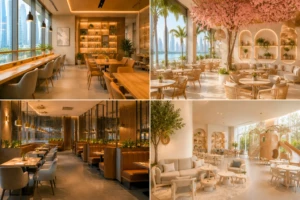
The Corporate Lunch Market operates out of DIFC, Downtown Dubai, and the Sheikh Zayed Road corridor. This guest needs privacy through booths or semi-enclosed seating, quick service pacing, and a menu that reads as worth expensing. Design signals quality through material finishes, not quantity of décor.
The Family Afternoon Market is strong in Abu Dhabi, Sharjah, and suburban Dubai communities like Dubai Hills and Al Quoz. This segment requires wider table spacing to accommodate prams, designated seating clusters that separate family zones from quieter areas, and child-friendly approach paths.
Get the guest profile wrong and you will spend your first six months retrofitting layout decisions that should have been made at the brief stage. Our blog on the importance of space planning in Dubai’s interior design goes deeper into how spatial decisions made early in a project determine commercial outcomes later.
The Bar Is the Heart – Design It as an Engine
The competitor guides and generic articles talk about bar placement in terms of aesthetics. In practice, your espresso bar is a production line, and it should be designed with the same logic a factory engineer applies to throughput.
The sequence that matters is order, then grind, then extract, then steam, then finish, then handoff.
Every extra step in this chain adds 8 to 12 seconds to service time. In a 100-cover cafe running at full capacity during the morning rush, that compounds into meaningful revenue loss across hundreds of transactions each week.
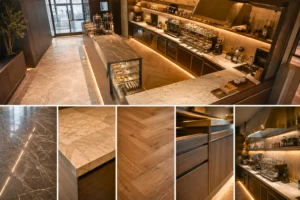
What the bar brief should specify for Dubai operators:
Bar depth should reach a minimum of 900mm front-to-back as a working depth standard. Anything less and baristas are colliding at peak service. Counter height should be in the range of 900 to 1050 mm. Higher counters create a natural screen between production and guests, which is desirable if your workflow is complex. Lower counters create visibility and intimacy, which suits specialty coffee concepts where the craft is the show.
Cold-side and hot-side separation is a requirement under UAE health regulations. Clear separation of cold food prep and hot equipment zones must be resolved in DM submission drawings before finishes are specified, not handled as an afterthought during construction.
Ventilation above espresso equipment is another early decision that many operators delay until it is expensive to resolve. Extraction hood placement affects ceiling design and overall height requirements, and it must be worked through in M&E drawings before the interior palette is finalised.
One principle that consistently gets ignored until it costs real money: the take-away queue and the dine-in journey must not intersect. In Dubai’s cafe culture, where take-away now accounts for 30 to 40 percent of transactions in high-footfall locations, a layout that funnels both through the same corridor creates a bottleneck that neither experience recovers from.
Zoning That Works for UAE Trading Patterns
Dubai cafe traffic does not follow a standard bell curve. It spikes sharply between 7:30 and 9:30 AM during the commuter rush, drops through midday as outdoor heat deters foot traffic, recovers from 4 PM onward, and runs a second strong evening period until 11 PM or midnight, particularly on Thursday and Friday nights.
Design zones need to accommodate this rhythm rather than a European model where lunch is the primary commercial window.
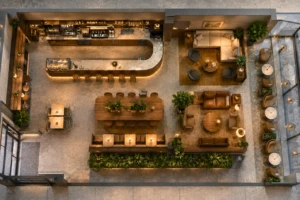
Practical zone architecture for a typical 80 to 150 sqm Dubai cafe:
Zone A is the Speed Strip positioned nearest the entrance. Bar stools, standing ledges, and two-top tables with minimal distance from the counter are the defining features. This zone exists to serve the 7 to 9 AM grab-and-go crowd without them penetrating the rest of the space. It should be bright, energetic, and designed for quick table turns.
Zone B is the Work Island positioned deeper in the plan. Four-top tables or long communal benches with discreet power integration work well here, placed away from the entrance corridor. Lower lighting and acoustic dampening above this zone help create the focus environment that remote workers and students will return for repeatedly.
Zone C is the social cluster positioned furthest from the counter. Low-slung seating, sofas, and armchairs arranged around lower tables define this area. This is your evening zone, your Thursday night zone, your stay-for-three-rounds zone. Negative space here is revenue-positive.
Zone D is Window Seating. In Dubai, where the street-facing façade is often the only natural light source given mall-adjacent or tower-ground-floor locations, window seating carries premium perceived value. Keep it visible from the entrance. It is both your brand’s shop window and your highest-willingness-to-pay seating area.
Our blog on co-working space interior design in Dubai explores in depth how zoning for different working and social modes can be structured across a hospitality space.
Thermal Comfort and the Design Challenge Nobody Writes About
Here is the question the competitor guides never ask: how does your cafe feel in August?
Dubai summers mean your HVAC system runs at full load for five months. Interior design decisions that appear purely aesthetic – a ceiling exposed to a concrete soffit, a west-facing glazed façade with no solar shading, dark stone flooring throughout – create thermal discomfort that no amount of air conditioning fully resolves in the middle of the afternoon.
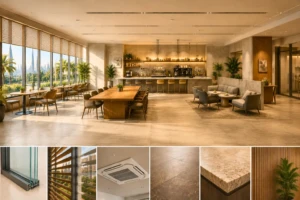
Our dedicated blog on interior design for Dubai’s hot climate covers the engineering and design principles behind this challenge in full, and it is required reading for any F&B operator planning a fit-out in Dubai.
Practical considerations UAE cafe designers must address at the brief stage:
Solar gain through glazing is the most common thermal problem in cafe fit-outs. West and south-facing facades need either low-e glass specification or internal solar shading that does not block the natural light that makes window seating valuable. Integrated fabric blinds or architectural fins are the workable solutions that balance both concerns.
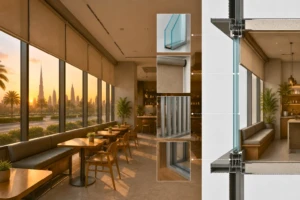
Cold aisle management is frequently overlooked. HVAC systems in UAE fit-outs are often designed for maximum cooling capacity rather than even distribution. Cold spots near vents and warm spots near entrances create a guest experience where every table feels different. Working with an M&E consultant to specify diffuser placement in tandem with seating layouts is the correct sequence.
Material surface temperature is a subtler consideration. Black stone tabletops and dark metal surfaces retain heat. If your cafe has any outdoor-to-indoor transition, even a short open-air entrance path, materials near that threshold should be chosen for thermal neutrality.
Lighting That Earns Its Cost Back
Lighting in cafe design is typically presented as an atmosphere question. In Dubai, it is also a content production question.
A meaningful percentage of your cafe’s marketing budget is effectively created by your guests through their phone cameras, their Instagram stories, and their TikTok walk-throughs. Lighting that photographs well is lighting that generates organic reach. In a city where social media discovery drives a measurable portion of new trial visits, that is a genuine commercial asset, not a vanity consideration.
Target specifications by zone:
| Zone | Lux Level | Colour Temperature |
| Dining and lounge seating | 150 to 200 lux | 2700 to 3000K |
| Bar counter and production | 200 to 300 lux | 3000 to 3500K |
| Back-of-house and prep | 400 to 500 lux | 4000K |
| Window feature or artwork | 300 lux or above (directional) | 2700 to 3000K |
What most guides skip is the relationship between phone photography and lux levels. Underlit spaces produce grainy images that do not circulate. Overlit spaces with flat ambient light eliminate the contrast and shadow that make a space look dramatic in photographs. The sweet spot is layered lighting: a low ambient base supplemented by accent and task sources that creates visual depth both in the room and in any image taken of it.
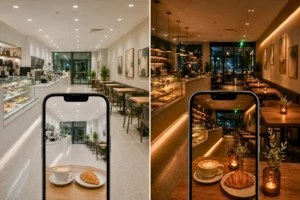
Avoid specifying a grid of recessed downlights as your primary lighting solution. It is the default because it is cheap to install. It is also the fastest route to making a cafe look like a supermarket.
Acoustics – The Hidden Revenue Variable
There is a measurable relationship between acoustic comfort and average spend. Research across hospitality environments consistently shows that guests at tables in high-ambient-noise conditions order fewer rounds, leave sooner, and rate their experience lower regardless of the quality of food or service.
In Dubai’s cafe market, acoustic failure follows a specific pattern. Most fit-outs feature polished concrete or porcelain tile floors which are highly reflective, an exposed ceiling with concrete or gypsum which is also highly reflective, and glass facades which add a third major reflective surface. Three reflective surfaces with no absorption in between produces a reverberation time that makes normal conversation require raised voices. Raised voices increase overall ambient noise, which requires further voice elevation, and the cycle continues.
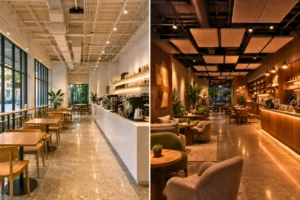
The fix does not require covering walls in foam or sacrificing the aesthetic.
Suspended acoustic baffles or clouds are high-NRC panels rated between 0.80 and 1.0 hung at 2.8 to 3.2 metres ceiling height. They absorb reflected energy without touching the aesthetic and can be integrated as design elements in timber-framed or fabric-wrapped forms.
Upholstered seating in at least 30 percent of the floorplan makes a meaningful acoustic contribution. Under-table acoustic matting beneath dining zone rugs adds further absorption at exactly the height where conversation happens. Cork or timber wall cladding in at least one continuous run contributes mid-frequency absorption, which is the frequency range of human speech.
The target reverberation time (RT60) for a cafe interior sits between 0.6 and 1.0 seconds. Above 1.2 seconds, conversation fatigue becomes noticeable and guests start leaving earlier than they otherwise would.
UAE-Specific Material Choices
The UAE’s humidity and temperature environment, combined with 12 to 16-hour operating days, puts fit-out materials under significantly more stress than European equivalents. Materials that hold up for three years in London may show accelerated wear in Dubai within 18 months. Choosing the wrong material is not just an aesthetic problem; it is a maintenance cost and a premature renovation cost.
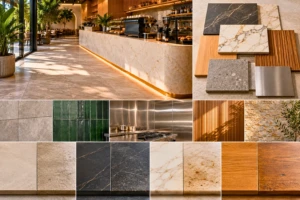
High-wear zones and what actually lasts:
Flooring at entry and counter zones should use rectified porcelain at 20 to 30mm thickness with an R10 to R11 slip rating for areas that experience condensation from cold drinks. Large-format tiles at 600x600mm and above mean fewer grout lines, which means less maintenance and a cleaner visual over time.
Counter surfaces in professional-grade cafe environments should be sintered stone such as Dekton or Neolith. These materials resist heat, staining, UV exposure, and the daily cleaning chemical cycle that destroys natural stone sealants within months in a cafe environment.
Wall cladding in kitchen-adjacent areas should avoid plaster finishes within splatter range. Large-format wall tiles with epoxy grout, or stainless steel sheet behind the espresso station, are the durable choices for these zones.
Timber finishes in coastal locations such as Dubai Marina or areas close to the water need moisture-resistant treatment. Engineered timber should be specified over solid timber in any location with high-humidity fluctuation.
The Dubai Municipality Permit Process and What It Means for Your Interior Brief
This is the section no competitor guide includes because it requires genuine local knowledge, and getting it wrong is expensive.
Dubai Municipality’s fit-out process for F&B establishments requires initial approval from the relevant authority, fit-out permit drawings submitted by a UAE-registered consultant, including architectural, MEP, civil defense, and health authority layouts, a Civil Defense NOC for fire suppression and emergency lighting, Health Authority approval for food-handling zones, and a final inspection before the trading license is issued.
The interior design brief must be aligned with compliance from the very beginning of the project. The common costly errors include specifying a kitchen layout that does not pass health authority food-zone segregation requirements, ceiling heights below the minimum DM standard of 2.6 meters clear height in F&B areas, insufficient emergency exit widths once furniture is placed, and disabled access non-compliance across ramp gradients, toilet dimensions, and counter height provisions.
At Paras Interiors, we work with UAE-registered consultants and submit DM-compliant drawings as part of our commercial interior design service. This removes a significant project risk from our clients’ hands and typically shortens the approval timeline compared to clients managing consultant coordination themselves.
Designing for the Instagram Economy Without Looking Like You Tried
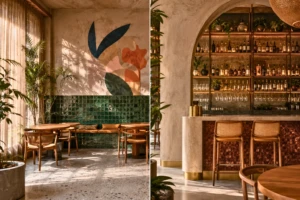
There is a fine line between a cafe that creates shareable moments and one that looks like it was designed by a marketing committee. Dubai audiences sophisticated and globally traveled, recognize the difference immediately.
What makes content without signalling “content creation space”?
A single, carefully considered wall treatment with genuine material interest works far better than a generic typographic wall covering. Zellige tile, hand-applied plaster, and commissioned murals from local artists all hold up far longer than trend-chasing surface treatments.
Window light managed through sheer curtaining creates shifting shadow patterns throughout the day that guests will photograph without being prompted. A visible back bar with depth and layering of bottles, glassware, planting, and accent lighting gives the eye somewhere to travel in a photograph and looks compelling across every social media format.
Unexpected material combinations are consistently the most photographed elements in successful cafes. Raw terrazzo paired with burnished brass, exposed concrete softened by rattan pendant lighting, and dark timber accented by a single run of hand-painted ceramic tile are examples of combinations that create the visual tension that registers in photography.
What to avoid in 2025 and 2026: neon signs with generic inspirational phrases, artificial flower walls, and gold-on-white colour schemes that were exhausted in Dubai circa 2019. If your space would look identical to fifty others, the design is not doing its job.
Our post on exploring Dubai’s interior design trends is a useful companion read for anyone building out a visual identity for a cafe or hospitality space in the UAE.
Brand Identity – The Final Layer, Not the First
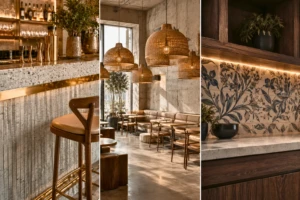
A consistent error in cafe interior briefs is starting with brand elements such as logo colour, signage, and graphic prints, then trying to build a design around them. Brand elements are the finishing layer of a well-conceived spatial design, not its foundation.
The correct sequence for a cafe brief: define the guest and the experience you are creating for them, then define the functional operational layout, then define the material palette and spatial atmosphere, then layer in brand elements, including typography, signage, packaging, and bespoke elements that reinforce rather than override the space.
In practical terms for Dubai cafe operators, your logo should appear in three places at most: the external façade, a considered single moment inside, such as the reception desk face, bar front, or one wall application, and your collateral across cups, packaging, and the menu. Beyond that, brand presence communicates anxiety rather than confidence. Restraint in branding consistently reads as higher quality to sophisticated guests.
Restaurant and Cafe Design as a Commercial Strategy
The best-performing F&B spaces in Dubai right now are the ones where the interior design functions as part of the commercial strategy, not as a cost line separate from it. This means the layout is engineered to increase revenue per square meter, the zoning is planned to maximize both table turns and dwell time depending on the hour, and the material specification is chosen to minimize maintenance and refresh costs over a three- to five-year horizon.
Our blog on restaurant interior design ideas covers this commercial design lens in detail for restaurant operators, and much of the thinking applies equally to cafe environments.
If you are exploring what a professionally managed commercial interior design project looks like from brief to handover, our overview of the five phases of the commercial interior design process explains exactly how projects of this type are structured at Paras Interiors.
For investors specifically, understanding why interior design directly affects the commercial value of a space is a useful framework for thinking about design as an investment rather than an expense.
Budget Benchmarks for Cafe Interior Fit-Outs in Dubai
These are real-market reference ranges for 2025 and 2026, not theoretical figures.
| Fit-Out Level | AED per sqft (supply and install) | Typical Profile |
| Standard commercial | AED 250 to 350 per sqft | Community cafe in JVC, Deira, or Sharjah |
| Mid-range | AED 350 to 500 per sqft | Neighbourhood destination cafe in Dubai Marina, JBR, or Mirdif |
| Premium | AED 500 to 750 per sqft | DIFC, Downtown Dubai, or Jumeirah concept cafe |
| Luxury and flagship | AED 750 and above per sqft | Mall flagship, branded hotel cafe, or ultra-concept space |
These ranges cover fit-out construction and FF&E, including furniture, fixtures, and equipment. They exclude kitchen equipment, POS systems, and soft-opening costs.
For a detailed breakdown of how these costs are structured across different property types and project scopes, our comprehensive guide to interior design cost per square foot in Dubai and our complete 2026 pricing guide both provide the granular cost architecture that investors and operators need before committing to a brief.
A workable rule of thumb for Dubai cafe investors: budget your interior fit-out at a minimum of 18 to 24 months of projected net revenue to ensure the space can sustain the commercial return period before requiring significant refresh.
How Long Does a Cafe Fit-Out Take in Dubai?
These are realistic timelines rather than optimistic projections.
Design and DM drawings typically take 4 to 8 weeks. DM approval and NOC processing takes 3 to 8 weeks and is variable, with free zones generally moving faster. Fit-out construction takes 6 to 14 weeks depending on scope. FF&E delivery and installation takes 2 to 4 weeks, longer if any items are imported. Soft opening and snagging takes 1 to 2 weeks.
Realistic total from brief to keys: 4 to 6 months for a standard scope project. Clients who begin engaging designers at the lease negotiation stage, before signing, consistently have smoother timelines and better outcomes than those who start after the lease is signed and the rent clock is already running.
If you are weighing whether to hire an integrated design-and-build firm versus a separate designer and contractor, our blog on why hiring an interior designer saves time and money addresses that decision in detail.
Where in the UAE Are We Seeing the Strongest Cafe Design Investment?
The highest concentration of well-executed cafe fit-outs is currently in DIFC, Downtown Dubai, and Dubai Marina, where premium fit-out investment is justified by the willingness to pay among the resident and visitor mix.
The highest growth in new cafe openings is in Business Bay, JVC, and Dubai Hills, where a growing residential population and limited established cafe competition create real opportunity for operators who can execute a well-designed space at the mid-range fit-out tier.
Al Quoz remains Dubai’s most design-literate neighborhood for F&B operators targeting a creative, arts-adjacent audience. The industrial warehouse aesthetic that dominated there for a decade is now being replaced by more sophisticated and considered interiors that retain the neighborhood’s DNA while meeting the quality expectations of a more cosmopolitan guest base.
In Abu Dhabi and Ajman, we are seeing increasing appetite for cafe concepts that blend contemporary design with cultural reference points, reflecting the different character of those markets compared to Dubai.
Working with Paras Interiors on Your Dubai Cafe Project
Paras Interiors brings 10 years of commercial interior design experience across Dubai and the wider UAE. Our cafe and restaurant design work integrates spatial design, material specification, FF&E procurement, and full fit-out contracting, managed as a single accountable project from brief to handover.
We work with clients from the earliest stage, including during lease negotiation, to ensure that the space you are committing to can accommodate the layout your concept requires. Our team is familiar with DM fit-out submission requirements across mainland Dubai and major free zones, and we coordinate civil defense and health authority approvals as part of standard project delivery.
You can explore our full services and project gallery to see the range of commercial and residential work we deliver. If you want to understand more about our team and approach before reaching out, our about us page covers our background and philosophy in detail.
If you are planning a cafe opening in Dubai, Abu Dhabi, Sharjah, or elsewhere in the UAE, we would welcome a conversation at the earliest stage of your planning.
Frequently Asked Questions
There is no universal best, but the styles performing best commercially in Dubai right now combine warm material palettes including warm timber, plaster, and terracotta tones with deliberate negative space, high-craft detailing in one or two elements, and a visual restraint that feels considered rather than minimal. The Instagram maximalism wave of 2018 to 2022 has receded. Longevity is the current luxury signal in this market.
Not necessarily. Integrated design-and-build firms like Paras Interiors manage both under one contract. This eliminates the coordination gap between designer and contractor that is one of the most common sources of project delays and cost overruns in UAE fit-out projects. Ensure whoever you engage has demonstrable experience with DM fit-out submissions for F&B spaces specifically.
Yes, but the layout decisions for each are in some tension. High take-away volume requires a counter design that separates take-away service from the dine-in queue, dedicated packaging and drinks pickup space, and ideally a separate entrance or queue routing. This needs to be specified at design stage; it cannot be adequately retrofitted after construction is complete.
Ramadan trading requirements in Dubai typically mandate opaque screening of dining areas from public view during fasting hours, separate screened entry for non-fasting customers in some locations, and modified external signage. Designing the entrance configuration and any operable screening requirements into your fit-out drawings from the start is the right approach. A retractable screen system or a purpose-designed entrance lobby costs significantly less to build during fit-out than to add post-completion.
The five we see most frequently at Paras Interiors: designing for Instagram rather than for guest comfort, ignoring acoustics until it is too late to fix them properly, underspecifying bar depth and workflow, choosing materials without UAE-market durability experience behind the selection, and beginning construction before all DM approvals are confirmed. Each one is avoidable with the right design partner engaged from day one.
Our commercial interior design services cover restaurants, cafes, retail environments, showrooms and exhibition areas, hospitality spaces, and office environments across Dubai and the wider UAE. We also deliver home interior design and office interior design services for clients across our service area network.