In the UAE’s rapidly expanding healthcare sector, clinic and medical facility design has evolved far beyond functional compliance. Today’s leading clinics in Dubai and Abu Dhabi understand that the built environment profoundly influences patient outcomes, staff performance, operational efficiency, and ultimately, business success in one of the world’s most competitive healthcare markets.
Clinic interior design in Dubai and Abu Dhabi represents a highly specialized discipline requiring simultaneous mastery of UAE regulatory requirements, evidence-based healthcare design principles, technical material science, and the hospitality-influenced patient experience standards that UAE patients now expect.
As a specialist interior design company in Dubai with extensive healthcare sector experience, Paras Interiors UAE has delivered medical fit-outs across the UAE that satisfy DHA and DOH regulatory requirements while creating genuinely healing, patient-centered environments. This comprehensive guide covers everything healthcare investors, clinic operators, and facility managers need to know.
The UAE Healthcare Design Landscape: Why It Matters More Than Ever
The UAE healthcare sector is experiencing unprecedented growth. With the UAE government targeting world-class healthcare delivery, medical tourism ambitions positioning Dubai and Abu Dhabi as global healthcare destinations, and private healthcare investment accelerating, clinic design standards have risen dramatically.
Market Context
- UAE healthcare market valued at approximately AED 73 billion in 2024 with continued strong growth projected
- Dubai Health Authority (DHA)-licensed facilities exceed 4,500 across the emirate
- Abu Dhabi Department of Health (DOH) oversees a similarly expanding provider network
- Medical tourism bringing 500,000+ international patients annually to UAE facilities
- Patient experience ratings increasingly influencing facility reputation and insurance panel placements
The Design Imperative: In this competitive environment, clinical excellence alone no longer differentiates. UAE patients, among the world’s most demanding healthcare consumers, evaluate facilities holistically. Physical environment quality directly influences the following:
- Patient perception of clinical quality (research consistently shows strong correlation)
- Patient anxiety levels affecting treatment outcomes
- Staff recruitment and retention in competitive UAE healthcare labor market
- Regulatory compliance and license maintenance
- Medical tourism appeal for international patient attraction
- Revenue per patient through enhanced service perception
UAE Regulatory Requirements: DHA and DOH Medical Fit-Out Compliance
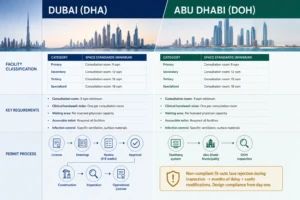
Understanding regulatory requirements is the essential starting point for any UAE clinic design project. Non-compliant fit-outs face rejection during DHA or DOH inspection, potentially delaying opening by months and requiring costly modifications.
Dubai Health Authority (DHA) Requirements
DHA regulates all healthcare facilities in the Dubai Emirate (excluding DHCC, which has its own framework). Key design-relevant requirements include:
Facility Classification Standards:
DHA classifies facilities into categories (Primary, Secondary, Tertiary, Specialized), each with specific space standards:
- General Practice/Primary Care Clinics: Minimum consultation room size 9 sqm, minimum waiting area provision per licensed physician
- Specialist Clinics: Additional space requirements for procedure rooms, equipment accommodation, and patient preparation areas
- Day Surgery and Procedure Facilities: Operating theater standards, recovery room requirements, sterilization unit specifications
- Diagnostic Facilities: Specific shielding requirements for imaging, controlled access zones, radiation protection compliance
Infection Control Requirements:
DHA’s healthcare facility standards mandate specific infection control design elements:
- Hand hygiene stations (clinical handwash sinks) within specified distances of patient contact areas
- Clinical handwash sink specifications (clinical-grade, hands-free operation, no overflow)
- Surface material compliance for clinical areas (seamless, non-porous, easily cleanable)
- Ventilation specifications, including air change rates and pressure differentials between clean and dirty zones
- Waste management facility provisions (clinical waste segregation and storage)
- Dirty utility room provisions in clinical wings
Space Planning Standards:
DHA specifies minimum dimensions for key clinical spaces:
| Space Type | DHA Minimum Requirement |
| Consultation room | 9 sqm minimum |
| Treatment/procedure room | 12–16 sqm depending on procedure type |
| Reception/waiting area | Calculated per licensed physician capacity |
| Clinical handwash sink | One per consultation room |
| Accessible toilet | Required in all facilities |
| Staff facilities | Separate from patient areas |
Permit Process:
DHA fit-out approval involves:
- Initial facility license application establishing concept approval
- Architectural drawing submission to DHA for review
- DHA technical review (typically 4–8 weeks)
- Conditional approval with specified requirements
- Construction and fit-out execution
- DHA inspection before operational license issuance
- Operational license granted upon satisfactory inspection
Timeline Implication: Investors must build DHA approval timeline into project schedules, opening dates cannot be assumed without approval confirmation.
Abu Dhabi Department of Health (DOH) Requirements
Abu Dhabi’s DOH (formerly HAAD) operates similar regulatory frameworks with some important distinctions:
Tawtheeq Healthcare Facility Licensing:
DOH’s Tawtheeq system manages facility licensing with specific physical environment requirements:
- Space standards generally aligned with DHA but with Abu Dhabi-specific specifications
- Specific requirements for each clinical specialty
- Environmental health compliance including ventilation and water quality standards
- Patient safety environment standards including slip resistance, sharps disposal, and emergency equipment provision
Abu Dhabi Municipality Building Requirements:
In addition to DOH clinical requirements, Abu Dhabi Municipality building regulations apply:
- Building permit requirements for fit-out works
- Civil Defence fire safety approval
- Accessibility compliance per UAE Federal standards
- MEP system approvals
HAAD/DOH Inspection Standards:
DOH inspections evaluate physical environment against:
- Cleanliness and infection control readiness
- Patient privacy provisions
- Accessibility compliance
- Emergency preparedness (space for emergency equipment access)
- Signage and wayfinding adequacy
Dubai Healthcare City (DHCC) Specific Requirements
DHCC operates as a specialized healthcare free zone with its own regulatory authority (DHCCA):
- Separate fit-out permit process from DM
- Specific DHCC design standards and approved material lists
- International healthcare facility standards integration (Joint Commission International alignment)
- Premium specification expectations reflecting DHCC’s positioning
Federal UAE Accessibility Standards
All healthcare facilities must comply with UAE Federal Law No. 29 of 2006 on Rights of Persons with Disabilities and associated technical standards:
- Accessible parking provision
- Ramp gradients (maximum 1:12 for healthcare facilities)
- Door widths (minimum 900mm clear opening for clinical areas)
- Accessible toilet provision (dimensions, grab rail placement, turning circle)
- Reception counter accessible section (maximum 760mm height)
- Lift provision in multi-story facilities
- Tactile paving at key decision points
- Signage meeting visual accessibility requirements
Design Integration: Experienced healthcare designers integrate accessibility requirements from concept stage, avoiding costly retro-fit modifications during construction.
Patient Experience Design Principles: Beyond Compliance to Healing
Regulatory compliance establishes the floor, not the ceiling, of excellent healthcare design. Leading UAE clinics differentiate through design that actively enhances patient experience and supports healing:
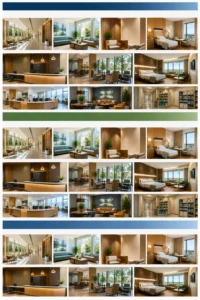
Principle 1: Anxiety Reduction Through Environmental Design
Medical anxiety is universal, patients arriving at clinics are often stressed, uncomfortable, and vulnerable. Environmental design can measurably reduce this anxiety:
Wayfinding Clarity:
Confused patients arriving at wrong areas, waiting in wrong queues, or unable to find facilities experience significant anxiety amplification. Clear, intuitive wayfinding design:
- Reduces stress before patients even reach clinical staff
- Decreases demands on reception staff for directional assistance
- Creates positive first impressions establishing facility confidence
- Reduces perception of waiting time through purposeful movement
Visual Calm:
Color psychology profoundly influences anxiety levels in clinical environments:
- Soft blues, greens, and neutrals demonstrate clinical research benefits for anxiety reduction
- Avoiding harsh whites and clinical grays that amplify institutional associations
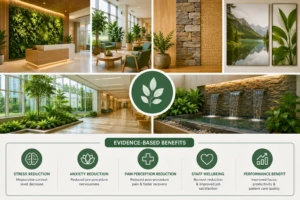
- Nature imagery and biophilic elements reducing physiological stress markers
- Avoiding visual complexity that creates cognitive overload in anxious patients
Acoustic Environment:
Clinical noise, equipment sounds, overheard conversations, HVAC systems, and telephone rings, amplifies patient anxiety. Design solutions:
- Sound-absorbing ceiling and wall materials in waiting areas
- Acoustic separation between consultation rooms protecting privacy
- Thoughtful equipment placement minimizing intrusive mechanical sounds
- Background music at appropriate levels in waiting areas (evidence supports nature sounds for anxiety reduction)
Privacy and Dignity:
Patient dignity preservation through spatial design:
- Reception desks with acoustic and visual privacy screens for registration
- Waiting arrangements that prevent patients from observing others’ clinical interactions
- Clinical areas with complete visual and acoustic privacy
- Changing areas with genuine privacy for examinations requiring undressing
Principle 2: The Hospitality Healthcare Model
UAE patient expectations, shaped by the emirate’s world-class hospitality industry, increasingly apply to healthcare environments:
Reception as Welcome Experience:
- Reception desk design conveying welcome rather than administrative gatekeeping
- Comfortable, hotel-lobby quality waiting seating
- Refreshment provision (water, beverages) as standard
- Digital check-in options reducing queue anxiety
- Dedicated staff position focused on patient experience rather than purely administrative function
Waiting Area Evolution:
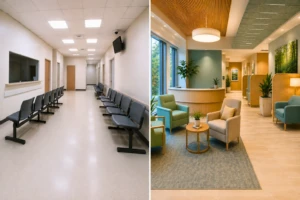
Modern UAE clinic waiting areas move beyond institutional row seating:
- Varied seating types accommodating different patient needs (families, elderly, mobility impaired)
- Individual privacy zones for patients preferring distance from others
- Children’s areas in family and pediatric practices
- Charging facilities for devices during wait
- Natural light maximization reducing institutional atmosphere
- Quality art and plant integration
VIP and Premium Offerings:
Dubai and Abu Dhabi’s patient demographics support premium healthcare experiences:
- Private waiting suites for VIP patients
- Concierge healthcare service areas
- Premium consultation rooms with luxury finishes
- Premium waiting areas with refreshments and privacy
Principle 3: Staff Environment Design
Healthcare staff spend entire working days in clinical environments, their environment quality directly impacts performance, wellbeing, and retention:
Clinical Staff Stations:
- Ergonomic design supporting extended documentation periods
- Natural light access for staff working areas where possible
- Clear sightlines to patient areas for monitoring
- Efficient layout minimizing unnecessary movement
Staff Rest and Break Areas:
- Genuine rest areas separated from clinical environment
- Quality staff facilities reflecting employer care
- Locker and changing provisions appropriate to staff numbers
- Private areas for prayer (particularly important in UAE context)
Workflow Efficiency:
Evidence-based clinical workflow design:
- Clean and dirty utility room positioning eliminating cross-contamination risk
- Medical supply storage at point of use reducing movement
- Equipment positioning reflecting actual clinical workflow
- Patient flow separation from staff movement where possible
Materials: Antimicrobial Surfaces and Healthcare-Appropriate Finishes
Material selection in clinical environments must satisfy simultaneous requirements: infection control performance, durability under intensive cleaning regimes, regulatory compliance, and aesthetic quality creating positive environments.
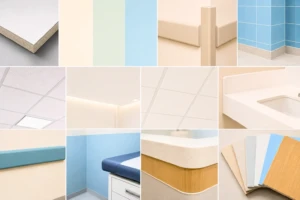
Flooring: The Foundation of Clinical Infection Control
Homogeneous Vinyl (LVT/PVC):
The clinical standard for UAE healthcare facilities:
- Seamless installation eliminating grout lines where bacteria accumulate
- Heat-welded seams creating fully monolithic barrier
- Antimicrobial additive options (silver ion technology)
- Resistance to clinical cleaning chemicals (bleach, quaternary ammonium compounds)
- Slip resistance meeting healthcare requirements (minimum R10 rating for clinical areas)
- Comfort underfoot during extended staff standing periods
- Cost-effective lifecycle with 15–25 year service life
Recommended Brands in UAE Market:
- Tarkett (iQ range specifically developed for healthcare)
- Forbo (Marmoleum and Sarlon clinical ranges)
- Armstrong Flooring (Medintone and Traditions clinical ranges)
Porcelain Tile (with specific considerations):
Appropriate for specific areas with careful specification:
- Entry areas and reception zones where aesthetic impact matters most
- Staff areas where clinical infection control is less critical
- Must specify R11+ slip resistance for wet areas
- Grout selection requires antimicrobial formulation
- Large format tiles minimizing grout joints where used in clinical areas
Carpet (Restricted Use):
Generally avoided in clinical areas but appropriate in:
- Waiting areas with careful specification (antimicrobial, bleach-cleanable, moisture-resistant backing)
- Staff rooms and non-clinical areas
- Never in areas with patient contact, bodily fluid risk, or high cleaning frequency requirement
Wall Finishes: Durability Meets Patient Environment
Impact-Resistant Plasterboard Systems:
Standard wall construction for most clinical areas:
- Impact-resistant boards (Knauf Aquapanel or similar) in high-traffic areas
- Vinyl-coated plasterboard in areas requiring frequent cleaning
- Epoxy-based paints over standard plasterboard in clinical areas (washable, semi-gloss minimum)
Antimicrobial Wall Paints:
Clinical-grade paint formulations for UAE healthcare environments:
- Silver ion antimicrobial technology reducing surface bacteria count
- Washable formulations withstanding repeated disinfection
- Healthcare-specific brands: Dulux Sterishield, Jotun Bioguard
- Color specification balancing aesthetic goals with clinical requirements
Wall Protection Systems:
Essential in high-traffic clinical corridors:
- Corner guards protecting vulnerable edges from equipment damage
- Crash rail systems (at wheelchair and trolley height) protecting walls
- Bed head protection panels in examination areas
- These elements require thoughtful integration rather than afterthought installation
Tiled Wet Areas:
Bathrooms, clinical handwash sink splashbacks, and wet procedure areas:
- Full-height tiling in wet areas
- Antimicrobial grout throughout
- Smooth surface tiles enabling effective cleaning (avoid heavily textured surfaces)
- Joint-less or minimized joint designs where possible
Ceilings: Balancing Clinical Function and Patient Experience
Suspended Acoustic Tile Systems:
Standard in most clinical areas:
- Antimicrobial tile specifications (Armstrong Ultima or similar healthcare tiles)
- Adequate plenum space for MEP infrastructure above
- Accessible design allowing maintenance without ceiling grid damage
- Fire-rated specifications as required by Civil Defence
Seamless Plasterboard Ceilings:
For reception and patient-facing areas where aesthetic quality matters most:
- Creates premium appearance aligned with hospitality healthcare model
- Requires careful MEP coordination during design
- Access panels integrated architecturally rather than creating clinical appearance
Wipeable Ceiling Tiles:
For clinical areas with infection control priorities:
- Smooth-faced tiles enabling ceiling surface cleaning (particularly important for high-risk clinical environments)
- Humidity-resistant specifications for areas with cleaning protocol intensity
Clinical-Specific Surface Requirements
Handwash Sink Surrounds:
- Solid surface materials (Corian, Staron) creating seamless joins
- Marine ply backing with waterproof membrane before tile or solid surface application
- Integral drainer channels directing water safely
Examination Couch Areas:
- Vinyl-capped wall areas at height likely to contact patient equipment
- Easy-clean flooring extending under equipment for cleaning access
- Adequate space around couches for staff access and infection control cleaning
Reception Desks:
- Solid surface countertops (non-porous, repairable scratches)
- Antimicrobial laminate options for cost-effective areas
- Stainless steel insets in areas with high disinfection requirements
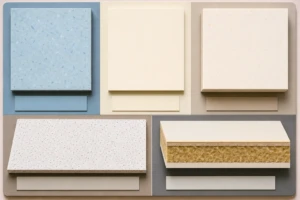
Wayfinding and Accessibility: Guiding Patients Confidently Through Your Facility
Effective wayfinding is invisible when it works and damaging to patient experience when it fails. In UAE healthcare facilities, wayfinding must serve diverse patient populations including Arabic speakers, international visitors, elderly patients, and those with visual or cognitive impairment.
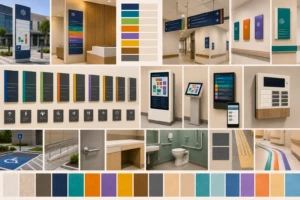
Wayfinding Design Principles for UAE Clinics
Hierarchy of Information:
- Primary wayfinding: Arrival orientation (parking, main entrance)
- Secondary wayfinding: Department and zone identification
- Tertiary wayfinding: Specific room and bay identification
Bilingual Requirements:
All UAE healthcare wayfinding must present information in Arabic and English as minimum. For facilities serving specific communities (South Asian, European), additional languages may serve commercial purposes even where not mandated.
Color Coding Systems:
Departmental color coding providing intuitive navigation:
- Each department or zone assigned a distinct color
- Color reinforced throughout journey (signage, flooring strips, wall accents)
- Colors accessible to color-blind populations (test designs using Ishihara principles)
Signage Specifications for UAE Healthcare:
- Minimum letter heights per viewing distances (typically 25mm per 3m of viewing distance)
- Pictogram integration serving multilingual populations
- Illuminated signage for emergency routes and key decision points
- Tactile signage at key points for visually impaired patients
- Regulatory compliance with UAE fire safety signage requirements
Digital Wayfinding:
Premium UAE healthcare facilities increasingly deploy:
- Digital directory boards at arrival points
- Interactive touchscreen wayfinding kiosks
- SMS-based appointment tracking reducing waiting room crowding
- Patient calling systems with visual and audio elements
Accessibility Integration
UAE Federal accessibility standards require specific provisions:
Movement and Access:
- Main entrance level access or ramped access (1:12 gradient maximum)
- Accessible parking spaces within 50m of accessible entrance
- Door hardware operable with closed fist (lever handles, not knobs)
- Automatic doors at main entrance reducing access effort for mobility-impaired
Reception Counter:
- Section of counter at maximum 760mm for wheelchair user access
- Clear floor space minimum 1500mm × 1500mm approaching counter
Accessible Toilet:
- Minimum dimensions 2,200mm × 1,500mm
- Grab rails at specified heights and positions
- Emergency call system
- Outward-opening door or sliding door for assisted access
Lift Provision:
Multi-level facilities require lifts meeting UAE accessibility standards:
- Minimum internal dimensions 1,100mm × 1,400mm
- Braille floor indicators
- Auditory floor announcements
Lighting Design for Clinical Environments
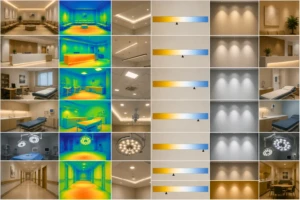
Lighting in healthcare facilities serves multiple simultaneous functions that general commercial lighting design doesn’t address:
Clinical Task Lighting
Accurate clinical assessment requires specific light quality:
Examination Lighting:
- Color rendering index (CRI) minimum 90 for clinical areas (standard office CRI 80 is insufficient)
- Color temperature 4,000–5,000K for neutral daylight equivalent in examination areas
- Illuminance levels: 500–1,000 lux at examination couch for general clinical assessment
- Shadow-free illumination (multiple source positions eliminating shadows)
- Dermatology: 1,000+ lux with CRI 95+ for accurate skin assessment
- Dental: Specialized dental operatory lighting with 10,000+ lux capability
Clinical Workstation Lighting:
- Screen-compatible lighting (avoiding reflections on monitor surfaces)
- Adjustable task lighting at clinical documentation positions
- Emergency lighting meeting Civil Defence requirements
Patient Environment Lighting
Contrasting with clinical task requirements, patient environment lighting prioritizes:
Anxiety Reduction:
- Softer, warmer color temperatures in waiting areas (2,700–3,500K)
- Avoidance of harsh overhead glare experienced as institutional
- Indirect and diffused light sources where possible
- Natural light maximization through glazing design
Circadian Support:
Evidence-based healthcare lighting recognizes circadian rhythm impact:
- Dynamic lighting systems adjusting color temperature through day
- Higher, cooler light supporting daytime alertness in staff areas
- Warmer, dimmer light in recovery and long-stay areas supporting rest
Specific Clinical Area Requirements:
| Clinical Area | Illuminance (lux) | CRI | Color Temperature |
| Waiting area | 200–300 | 80+ | 3,000–3,500K |
| Reception desk | 300–500 | 80+ | 3,500–4,000K |
| Consultation room | 300–500 general, 500–1000 examination | 90+ | 4,000–5,000K |
| Treatment room | 500–1,000+ | 90+ | 4,000–5,000K |
| Minor procedure | 1,000+ | 90+ | 4,500–5,000K |
| Corridors | 100–200 | 80+ | 3,500–4,000K |
| Staff rooms | 200–300 | 80+ | 3,000–3,500K |
Case Study: Multi-Specialty Clinic Transformation in Dubai
A private multi-specialty clinic in Dubai’s medical district approached Paras Interiors UAE to transform an existing 650 sqm facility that had been operating for several years but was failing to compete effectively with newer, premium competitors.
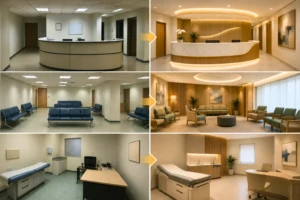
The Challenge
The clinic faced several interconnected problems rooted in its physical environment:
Patient Experience Issues:
- Cramped waiting area with institutional seating creating negative first impressions
- Confusing layout requiring staff intervention to direct virtually every patient
- Dated aesthetic signaling older, less sophisticated care perception
- Noise from reception desk audible throughout clinical area compromising privacy
Operational Issues:
- Inefficient staff movement patterns creating unnecessary delays
- Inadequate handwash sink provision requiring DHA compliance upgrade
- Storage deficiencies creating cluttered clinical areas
Business Impact:
- Patient satisfaction scores below competitor benchmarks
- Staff retention challenges partly attributed to challenging environment
- Inability to attract certain specialist physicians requiring premium facility standards
The Paras Interiors UAE Solution
Phase 1: Regulatory Compliance Audit and Design
Our team conducted a comprehensive DHA compliance audit identifying specific gaps requiring resolution:
- Two additional clinical handwash sinks required
- Minimum consultation room dimensions requiring layout modification
- Ventilation provision requiring HVAC upgrade
- Accessibility improvements required at reception counter
These compliance requirements drove the fundamental redesign rather than being retrofitted into aesthetic decisions, ensuring the final design was regulatory compliant from concept rather than modified post-design.
Phase 2: Patient Journey Redesign
Working from patient arrival to clinical consultation to departure, we redesigned the complete patient journey:
- New arrival sequence with clear visual orientation from entrance
- Color-coded departmental wayfinding integrated throughout
- Reception redesigned with acoustic privacy screen and accessible counter section
- Waiting area expanded through intelligent space planning to accommodate 35% more patients in equivalent space
- Natural light brought into waiting area through internal glazing modification
- Premium material selection replacing dated vinyl tiles with contemporary LVT flooring
Phase 3: Clinical Environment Enhancement
- All clinical surfaces upgraded to DHA-compliant specifications
- Impact-resistant wall systems installed in all clinical corridors
- Examination room lighting upgraded to CRI 90+ healthcare specification
- Acoustic separation between consultation rooms improved through partition upgrade
- Clean utility and dirty utility rooms redesigned for proper infection control workflow
Phase 4: Hospitality Healthcare Integration
- Reception desk redesigned with Corian solid surface countertop and integrated lighting
- Premium waiting furniture replacing institutional seating
- Refreshment station installed in waiting area
- Artwork curation introducing calming natural imagery
- Reception and consultation rooms repainted in evidence-based anxiety-reducing palette (soft sage and warm neutral combination)
- Biophilic plant integration throughout waiting areas
The Results (12 Months Post-Opening)
- Patient satisfaction scores increased by 34% in post-redesign surveys
- New patient acquisition rate increased 28% (attributed to referrals and online review improvement)
- Staff satisfaction with work environment improved significantly (quarterly survey data)
- DHA inspection completed without observations or required modifications
- Two additional specialist physicians recruited, attributing facility quality as factor in choosing this clinic over competitors
- Revenue per patient visit increased through introduction of premium consultation room tier
Investment Analysis: What Does Clinic Interior Design Cost in UAE?
Healthcare fit-outs carry higher per-sqft costs than standard commercial spaces due to compliance requirements and material specifications:
Cost Ranges for UAE Clinic Interior Design
| Facility Type | Economy Fit-Out | Standard Compliant | Premium Healthcare | Luxury/VIP |
| GP/Primary Care | AED 1,200–1,800 psm | AED 1,800–2,800 psm | AED 2,800–4,000 psm | AED 4,000+ psm |
| Specialist Clinic | AED 1,500–2,200 psm | AED 2,200–3,500 psm | AED 3,500–5,000 psm | AED 5,000+ psm |
| Dental Practice | AED 2,000–3,000 psm | AED 3,000–4,500 psm | AED 4,500–7,000 psm | AED 7,000+ psm |
| Day Surgery | AED 3,500–5,000 psm | AED 5,000–8,000 psm | AED 8,000–12,000 psm | AED 12,000+ psm |
Costs per square meter, inclusive of design, materials, furniture, fit-out construction, and project management. Exclusive of specialist medical equipment, DHA/DOH fees, and building permit costs.
Key Cost Drivers
- Regulatory Compliance: DHA/DOH compliant specifications represent unavoidable cost minimum. Attempting to design below compliance levels risks approval failure, requiring costly modifications.
- Mechanical and Electrical Systems: Healthcare ventilation requirements (specific air change rates, pressure differentials) often require significant HVAC investment beyond standard commercial specifications.
- Acoustic Specifications: Clinical privacy requirements demand higher-specification acoustic partitions than standard commercial fit-out.
- Material Durability: Healthcare-grade materials cost more initially but deliver significantly longer service life under intensive cleaning regimes.
For comprehensive commercial fit-out cost analysis, visit our commercial fit-out cost Dubai resource. For Abu Dhabi projects, explore our interior design Abu Dhabi services.
Why Choose Paras Interiors UAE for Your Clinic Design Project
Healthcare facility design requires specialized expertise that general commercial interior designers cannot provide. At Paras Interiors UAE, our healthcare design capability includes:
- Regulatory Expertise: Deep familiarity with DHA, DOH, DHCC, and Abu Dhabi Municipality requirements enabling efficient approval navigation without costly design revisions.
- Evidence-Based Design: Our healthcare designs incorporate current research on patient experience, infection control, and staff performance-creating environments with measurable impact beyond aesthetic improvement.
- Material Specification Knowledge: Understanding which materials meet clinical performance requirements while delivering design quality is specialized knowledge developed through multiple healthcare projects.
- Project Management: Healthcare projects must open on schedule, delayed openings mean revenue loss and staff management complexity. Our project management capability delivers on-time completion.
- Complete Turnkey Service: From DHA submission drawings through final clinic opening, we manage every element of your facility’s design and fit-out.
Explore our comprehensive commercial interior design Dubai capabilities or contact us directly to discuss your healthcare project.
Conclusion: Healthcare Design as Clinical and Commercial Investment
In Dubai and Abu Dhabi’s competitive healthcare markets, clinic interior design is simultaneously a regulatory requirement, a clinical quality factor, a staff welfare investment, and a commercial differentiator. Facilities that recognize this multidimensional value and invest accordingly consistently outperform those treating design as a cost to minimize.
The evidence is compelling: better-designed healthcare environments produce better patient experiences, better staff performance, better regulatory outcomes, and better business results. In the UAE’s ambitious, quality-focused healthcare market, design excellence isn’t a luxury, it’s a competitive necessity.
Planning a clinic fit-out in Dubai or Abu Dhabi?
Contact Paras Interiors UAE for a specialized healthcare design consultation. Our team combines regulatory expertise, evidence-based design capability, and UAE market knowledge to create clinic environments that genuinely serve patients, support staff, and deliver on your investment.
Frequently Asked Questions
Medical interior design goes beyond aesthetics by creating environments that improve patient comfort, support staff efficiency, enhance infection control, and comply with UAE healthcare regulations. Well-designed healthcare spaces can also reduce patient anxiety and improve overall experiences.
Clinic interiors in Dubai and Abu Dhabi must comply with requirements set by authorities such as the Dubai Health Authority (DHA), Department of Health (DOH) Abu Dhabi, Civil Defence, and local municipality regulations. These standards cover accessibility, infection control, ventilation, room sizes, and patient safety.
Patient-centered clinic design focuses on comfortable waiting areas, intuitive wayfinding, calming color schemes, natural lighting, acoustic privacy, ergonomic furniture, and layouts that reduce stress while supporting efficient healthcare delivery.
Effective healthcare design optimizes patient flow, minimizes staff travel distances, improves space utilization, and ensures treatment rooms, consultation areas, and support spaces are strategically located to streamline daily operations.
Medical facilities typically require durable, non-porous, easy-to-clean, and antimicrobial materials. Common choices include healthcare-grade flooring, hygienic wall finishes, seamless surfaces, and moisture-resistant cabinetry that support infection prevention protocols.
Yes. Modern clinic interior design balances regulatory compliance with aesthetics by incorporating biophilic elements, calming colors, premium finishes, natural lighting, and brand-focused design while still meeting healthcare standards and safety requirements.