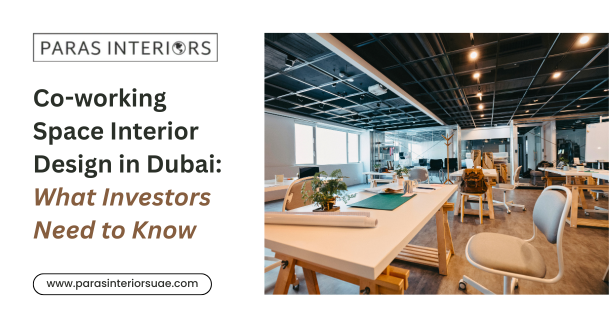
Co-working Space Interior Design in Dubai: What Investors Need to Know
Dubai’s commercial real estate landscape is undergoing a fundamental transformation. The hybrid work revolution, accelerated by global shifts in professional culture and enthusiastically embraced by the UAE’s dynamic business community, has created extraordinary demand for intelligently designed co-working spaces across the emirate.
For investors eyeing this lucrative market, understanding co-working space interior design in Dubai isn’t just about aesthetics—it’s about creating environments that attract and retain members, command premium pricing, satisfy regulatory requirements, and deliver sustainable returns in one of the world’s most competitive commercial markets.
As specialists in office interior design in Dubai, Paras Interiors UAE has worked with co-working space investors and operators across the emirate. This comprehensive guide shares everything you need to know before committing your investment to Dubai’s booming flexible workspace sector.
Dubai’s Co-working Boom: Understanding the Market Opportunity
Before examining design principles, understanding the demand drivers helps investors appreciate why co-working space design quality directly impacts financial performance:
The Hybrid Work Revolution in UAE
Dubai’s professional landscape has permanently shifted. Research indicates that over 65% of UAE knowledge workers now operate in hybrid arrangements, splitting time between home, client sites, and flexible workspaces. This structural change in how people work creates sustained, growing demand for quality co-working environments.
Key demand drivers in Dubai specifically:
- Entrepreneurship Ecosystem: Dubai’s aggressive startup visa programs, free zone proliferation, and government-backed entrepreneurship initiatives have created tens of thousands of new businesses requiring flexible workspace without long-term lease commitments.
- International Business Hub: Dubai serves as the regional headquarters for hundreds of multinational corporations whose employees need professional working environments during UAE visits or regional postings-without committing to dedicated office leases.
- Freelance Economy Growth: The UAE’s freelance and independent professional community has grown dramatically, with government freelance permits enabling thousands of professionals to work independently-creating natural co-working space demand.
- Real Estate Flexibility Premium: As Dubai commercial real estate remains expensive, businesses increasingly prefer flexible workspace arrangements that allow scaling without the financial commitment of traditional office leases.
- Digital Nomad Attraction: Dubai’s digital nomad visa and lifestyle appeal attract international remote workers who need professional workspace during UAE stays.
Dubai Co-working Market Statistics
- Dubai has over 150 formal co-working operators ranging from global brands (WeWork, Regus, IWG) to boutique local operators
- Average co-working membership rates range from AED 800–5,000+ monthly depending on access and amenities
- Dedicated desk rates: AED 2,000–8,000 monthly
- Private office suites: AED 5,000–30,000+ monthly
- Occupancy rates at well-designed premium spaces consistently exceed 85%
- Premium co-working spaces command 40–60% higher membership rates than basic competitors
This market context makes one thing clear: design quality directly determines your competitive positioning and financial performance.
Co-working Space Design Principles: Creating Spaces That Members Choose
Exceptional co-working design goes far beyond attractive aesthetics. It requires deep understanding of how different people work, what they need from flexible environments, and how design can facilitate community while protecting individual productivity.
Principle 1: The Zoning Hierarchy
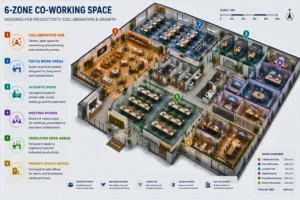
World-class co-working spaces create distinct zones matched to different work modes. This zoning isn’t accidental decoration-it’s strategic design serving specific functional and commercial purposes:
Zone 1: Collaborative Hub Areas
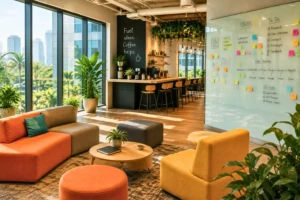
The social heart of your co-working space, designed for:
- Impromptu meetings and casual collaboration
- Community events and networking
- High-energy brainstorming sessions
- Informal client meetings
Design characteristics:
- Open, flexible furniture arrangements (movable tables and seating)
- Warm, inviting colors and materials promoting conversation
- Higher ambient noise tolerance built into acoustic design
- Writable surfaces (glass walls, chalkboard finishes, whiteboard panels)
- Power access throughout for laptop-working groups
- Café or refreshment proximity for extended informal meetings
- Natural light maximization for energy and alertness
- Higher ceiling treatments creating spacious, open atmosphere
Commercial function: This zone creates community identity and drives membership renewals through the sense of belonging it generates.
Zone 2: Focus Work Areas
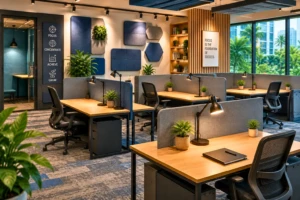
Individual productivity spaces where deep work happens:
- Open plan quiet zones for individual concentration
- Library-atmosphere areas for research and writing
- Focused desk areas for sustained productive sessions
Design characteristics:
- Acoustic separation from collaborative zones (physical and material)
- Lower sound levels through soft furnishings and sound-absorbing materials
- Individual task lighting at each workspace
- Privacy screens between desks without full enclosure
- Ergonomic seating for extended working periods
- Minimal visual distraction through neutral, calm finishes
- Temperature zoning allowing individual climate control where possible
- Plentiful power and data access at every position
Commercial function: Focus areas attract professional members who need genuine productivity environments-typically higher-value, longer-term members.
Zone 3: Acoustic Focus Pods
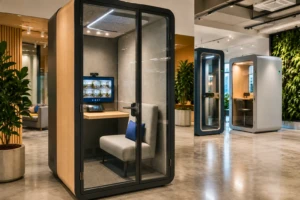
The most private open-area option short of enclosed rooms:
- Individual acoustic booths for phone calls and video conferences
- Small group pods (2–4 person) for confidential discussions
- Phone call booths for frequent callers
Design characteristics:
- Self-contained acoustic enclosures achieving 20–30dB sound reduction
- Integrated ventilation preventing stuffiness during extended use
- Interior lighting optimized for video conferencing (flattering, shadow-reducing)
- Thoughtful camera-height positioning for video calls
- Charging and data connectivity built into pod design
- Sound-absorbing interior materials (felt, fabric panels, acoustic foam)
- Clear glass panels maintaining visual connection to surroundings while providing acoustic separation
Investment consideration: Quality acoustic pods are significant investments (AED 8,000–35,000 each depending on size and specification), but are among the most-used and highest-satisfaction facilities in any co-working space.
Zone 4: Meeting Rooms
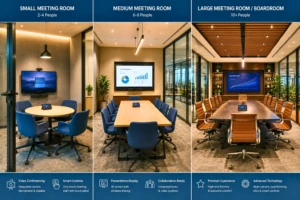
Bookable private rooms accommodating formal meetings, client presentations, and confidential discussions:
- Small (2–4 person): For focused working pairs or small group meetings
- Medium (6–8 person): For team meetings and presentations
- Large (10–20 person): For training, workshops, and larger client presentations
- Board room (10–14 person): Premium meeting experience for important presentations
Design characteristics:
- Complete acoustic privacy between rooms and from open areas
- Professional presentation technology (large displays, video conferencing systems)
- Credible, impressive design reflecting well on member businesses
- Good lighting for video calls (consistent, adjustable)
- Ergonomic seating for extended meeting comfort
- Accessible charging throughout
- Intuitive room booking system integration (wall-mounted tablet or touchscreen)
Commercial function: Meeting rooms generate significant revenue through hourly booking charges (AED 100–600+ per hour depending on size and specification) while justifying premium membership tiers that include meeting room credits.
Zone 5: Dedicated Desk Areas
Permanent, assigned workstations for members who use the space regularly:
- Personal storage (lockable pedestal or locker)
- Personalization options for members to make space their own
- Consistent ergonomic setup members can rely on
- Premium position within open plan areas
Design characteristics:
- Quality ergonomic seating (investing in good chairs pays dividends in member satisfaction)
- Height-adjustable desks increasingly expected at premium price points
- Integrated power, USB, and data connectivity
- Personal storage solutions
- Task lighting independent of ambient lighting
- Cable management maintaining professional appearance
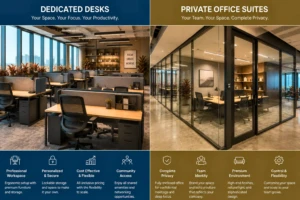
Zone 6: Private Office Suites
The highest-revenue product in most co-working operations:
- Lockable, fully enclosed offices for teams of 1–20 people
- Complete privacy for confidential work
- Personalizable for member identity
Design characteristics:
- Full acoustic and visual privacy
- Professional business environment reflecting on occupant companies
- Technology infrastructure matching enterprise expectations
- Branding flexibility allowing member identity expression within design framework
- Premium finishes justifying premium rental rates
- Direct access to co-working common areas for amenity benefits
Commercial rationale: Private suites command 3–5x the revenue per square foot of open membership areas. Their design quality directly impacts achievable rental rates.
Principle 2: Acoustic Design Excellence
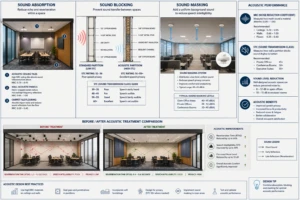
Acoustics represent the single most critical technical element of co-working space design—and the most commonly underinvested area by first-time operators.
The Co-working Acoustic Challenge:
Co-working spaces must simultaneously support quiet focused work, lively collaborative conversation, private phone calls, and confidential meetings—often within meters of each other. Without sophisticated acoustic design, the entire space becomes unusable for any serious work purpose.
Acoustic Design Strategies for Dubai Co-working Spaces:
Sound Absorption Materials:
- Acoustic ceiling tiles and panels (NRC rating 0.80+ for heavy absorption areas)
- Fabric-wrapped wall panels in collaborative zones
- Carpet or acoustic flooring in focus areas
- Upholstered furniture reducing hard surface reflections
- Acoustic baffles suspended from ceilings in open areas
Sound Blocking (Isolation):
- Full-height partitions with acoustic insulation between meeting rooms
- Acoustic-rated door sets with seals minimizing sound transmission
- Glazed partitions with acoustic laminated glass
- Double-glazing for private office suites
- Decoupled floor-ceiling constructions in critical acoustic areas
Sound Masking:
Modern co-working spaces increasingly employ electronic sound masking systems—speakers emitting subtle background sound that raises the ambient noise floor, making conversation less intelligible beyond a meter or two. This technology:
- Costs AED 50,000–200,000 for comprehensive system installation
- Dramatically improves perceived privacy without physical construction
- Allows higher occupancy without acoustic discomfort
- Is adjustable for different zones and times of day
Dubai-Specific Consideration: Dubai’s typically hard-surface aesthetic preferences (marble, glass, concrete) create challenging acoustic environments. Co-working spaces require deliberate countermeasures balancing design aesthetics with acoustic performance.
Principle 3: Biophilic Integration for Productivity and Well-Being
Research consistently demonstrates that nature integration in workspaces improves productivity, reduces stress, and increases space satisfaction—directly impacting co-working membership retention:
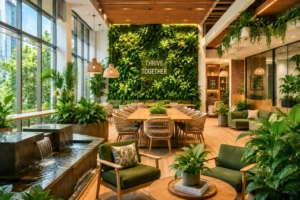
Practical Biophilic Elements for Dubai Co-working:
- Living plant walls creating focal points while improving air quality
- Abundant natural plants throughout collaborative zones
- Maximum natural light through strategic glazing
- Natural material integration (wood surfaces, stone accents, natural fibers)
- Water features in reception or main collaborative areas
- Views to outdoor spaces where architecture permits
Investment Return: Co-working spaces with strong biophilic design command 15–25% higher membership rates while achieving better retention than comparable spaces without nature integration.
Principle 4: Technology Infrastructure as Design Element
Dubai’s tech-forward co-working market demands infrastructure that matches professional expectations:
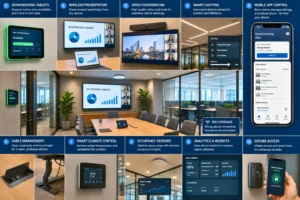
Essential Technology Integration:
Connectivity Infrastructure:
- Enterprise-grade WiFi with minimum 1Gbps leased line (dual-provider redundancy recommended)
- Structured cabling throughout all work areas
- Multiple SSID options (members, guests, secure)
- Consistent coverage with no dead zones verified through heat mapping
Smart Building Systems:
- Automated room booking systems (Robin, Envoy, Nexudus or similar)
- Smart access control (mobile app, keycard, or biometric entry)
- Automated visitor management
- IoT occupancy sensors enabling space utilization data
- Smart lighting with occupancy response and scheduling
- Environmental monitoring (CO2, temperature, humidity) displayed to members
- Power consumption monitoring for sustainability reporting
Member Technology:
- Large format displays in all meeting rooms (85″+ in large rooms)
- Wireless presentation systems (Clickshare, Google Cast, AirPlay)
- Video conferencing equipment (camera, microphone, speaker in all meeting rooms)
- Dedicated print stations with secure print release
- Lockers with mobile app management for hot desk members
Investment Consideration: Technology infrastructure for a 5,000 sqft co-working space typically costs AED 250,000–600,000 depending on specification. This investment is non-negotiable for premium market positioning and increasingly expected even in mid-market operations.
DTCM and DED Licensing: Design Implications for Dubai Co-working Spaces
Regulatory compliance shapes design requirements in ways investors must understand before committing to layouts and specifications:
DED (Department of Economic Development) Licensing
Co-working space operations in Dubai require DED commercial licensing (or equivalent free zone authority licensing):
License Classification: Co-working spaces typically operate under business center, serviced office, or commercial real estate categories.
Design Implications:
- Minimum reception area requirements for certain license categories
- Specific fire safety and emergency egress requirements affecting layout
- Accessibility requirements per UAE construction specifications
- Specific bathroom and amenity ratios per occupancy levels
- Air quality standards requiring adequate ventilation specification
Dubai Municipality (DM) Fit-Out Requirements
Commercial fit-outs in Dubai require DM approval for most modifications:
Permit Requirements:
- Fit-out permit for any modifications to existing spaces
- Structural modification permits for wall additions or removals
- Mechanical, electrical, and plumbing (MEP) permits
- Fire suppression and detection system approvals from Dubai Civil Defence
- DEWA approval for electrical load increases
Design Impact:
- Civil Defence requirements mandate specific fire exit widths (minimum 1,200mm for primary exits)
- Emergency lighting and signage throughout (affecting ceiling design)
- Specific sprinkler coverage requirements affecting ceiling design
- Smoke detector placement affecting ceiling layouts
- Fire-rated partition requirements between certain zones
Timeline: Dubai regulatory approvals typically add 4–8 weeks to project schedules. Experienced fit-out specialists like Paras Interiors UAE manage this process efficiently, but investors must factor this into opening timelines.
Free Zone Considerations
Many Dubai co-working spaces operate within free zones (DIFC, DMCC, Dubai Internet City, and Dubai Media City):
Free Zone Fit-Out Requirements:
- Each free zone has specific fit-out guidelines and approval processes
- Approved contractor lists in some zones limit designer and contractor selection
- Specific technical standards for MEP, fire safety, and access control
- Higher specification requirements in premium zones (DIFC particularly stringent)
- Separate free zone permit process in addition to or replacing DM process
DTCM Implications: If co-working spaces incorporate hospitality elements (cafe, restaurant, event spaces with food service), DTCM licensing requirements add additional regulatory layers affecting kitchen design, ventilation, and food handling facility specifications.
Professional Advice: Navigating Dubai’s regulatory landscape for co-working spaces requires specialized local knowledge. Engaging experienced fit-out specialists from project inception prevents costly redesigns and delays.
Cost Analysis: What Does Co-working Space Design Cost in Dubai?
Investment planning requires understanding realistic cost ranges. Here’s the 2026 market breakdown:
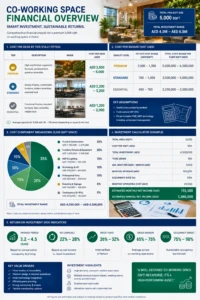
Cost Per Desk: The Key Metric
Co-working investors typically analyze costs on a per-desk basis, as desk count determines revenue capacity:
| Specification Tier | Cost Per Desk (AED) | Achievable Monthly Rate | Payback Period (Desk) |
| Economy | AED 8,000–12,000 | AED 800–1,500 | 6–12 months |
| Mid-range | AED 12,000–20,000 | AED 1,500–2,500 | 7–12 months |
| Premium | AED 20,000–35,000 | AED 2,500–4,000 | 8–14 months |
| Luxury | AED 35,000–60,000+ | AED 4,000–8,000+ | 9–15 months |
Note: Cost per desk calculations divide total fit-out investment by total desk count (open desks + dedicated desks + private office desk equivalents)
Cost Per Square Foot: Dubai Co-working Market 2026
| Fit-Out Tier | Per Sqft Range | Total for 5,000 sqft Space |
| Economy/basic | AED 300–450 | AED 1,500,000–2,250,000 |
| Mid-range | AED 450–650 | AED 2,250,000–3,250,000 |
| Premium | AED 650–900 | AED 3,250,000–4,500,000 |
| Luxury flagship | AED 900–1,500+ | AED 4,500,000–7,500,000+ |
For detailed commercial fit-out cost analysis, visit our comprehensive commercial fit-out cost Dubai guide.
Cost Component Breakdown for Typical 5,000 sqft Premium Co-working Space
| Component | Estimated Cost | % of Total |
| Construction and fit-out | AED 800,000–1,200,000 | 28–33% |
| Furniture and seating | AED 600,000–900,000 | 22–25% |
| Technology and AV | AED 300,000–500,000 | 11–14% |
| Acoustic solutions | AED 150,000–250,000 | 5–7% |
| Lighting design | AED 100,000–200,000 | 4–6% |
| Acoustic pods | AED 120,000–200,000 | 4–6% |
| Design and project management | AED 200,000–350,000 | 7–10% |
| Regulatory permits and fees | AED 50,000–100,000 | 2–3% |
| Smart technology/IoT | AED 100,000–200,000 | 4–6% |
| Branding and signage | AED 50,000–120,000 | 2–4% |
| Contingency (15%) | AED 300,000–450,000 | 10–12% |
| TOTAL | AED 2,770,000–4,470,000 | 100% |
Revenue Model Validation
For a premium 5,000 sqft space (approximately 120 desks equivalent capacity):
Revenue Potential:
- 40 hot desks at AED 1,800/month average: AED 72,000/month
- 30 dedicated desks at AED 3,500/month: AED 105,000/month
- 10 private offices (2–4 person) at AED 12,000/month: AED 120,000/month
- Meeting room revenue at 40% occupancy: AED 60,000/month
- Virtual office memberships (50) at AED 500/month: AED 25,000/month
- Total potential monthly revenue: AED 382,000
At 75% occupancy (realistic operational target):
- Monthly revenue: AED 286,500
- Less operating costs (rent, staff, utilities, maintenance): AED 180,000–220,000
- Monthly profit before depreciation: AED 66,500–106,500
- Annual profit: AED 798,000–1,278,000
Against investment of AED 3.5M: 2.7–4.4 year payback at target occupancy-demonstrating why quality design investment is justified financially.
Best Areas for Co-working Fit-Outs in Dubai: Location Intelligence
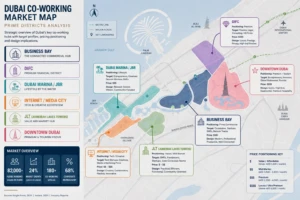
Location profoundly influences co-working space design requirements, target member profile, and achievable pricing:
Business Bay: The Prime Co-working District
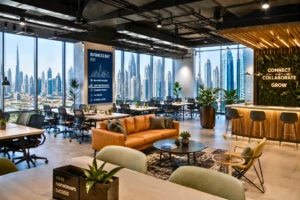
Business Bay has emerged as Dubai’s most active co-working market, driven by:
- High density of SMEs and startups
- Mix of residential and commercial creating hybrid worker population
- Excellent transport connections (Metro, RTA bus, water taxi)
- Premium address appeal at accessible rental rates compared to DIFC
Design Implications for Business Bay:
- Members skew younger and tech-oriented, design should reflect contemporary, dynamic aesthetics
- Networking community elements particularly valued
- Premium technology expectations, enterprise WiFi, video conferencing standard
- Rooftop or view access highly valued where available
Explore our specialized interior design Business Bay expertise for location-specific design guidance.
DIFC (Dubai International Financial Centre)
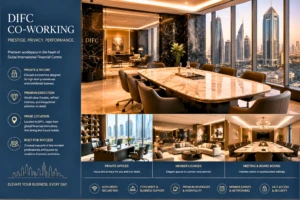
The premium tier of Dubai co-working demand, serving financial services professionals, legal firms, and global corporations:
Design Implications for DIFC:
- Highest specification expectations in market—marble, premium materials standard
- Privacy and confidentiality paramount in design
- Larger meeting room provision for client entertainment
- Member profile expects financial district credibility—conservative, sophisticated design
- DIFC regulatory requirements more stringent than mainland Dubai
- Premium pricing justified through exceptional design execution
Typical Psf Investment: AED 900–1,500+ for DIFC co-working spaces meeting market expectations. Explore Interior Design Company in DIFC services.
Dubai Marina and JBR
Lifestyle-oriented co-working serving digital entrepreneurs, creative professionals, and lifestyle businesses:
Design Implications:
- Strong lifestyle branding and community identity
- Outdoor terrace integration highly valuable
- Casual aesthetic with premium execution
- Instagram-worthy spaces driving organic marketing
- Members value community events and social programming
Explore Interior Design Company in dubai marina services.
Dubai Internet City and Media City
Technology and media sector professionals create specific design needs:
Design Implications:
- Podcast studios and content creation spaces command premium
- Studio lighting provisions valued
- Technical infrastructure at highest specification
- Creative, vibrant aesthetics reflecting member industries
- Event spaces for tech community gatherings
JLT (Jumeirah Lakes Towers)
Value-oriented mid-market co-working serving SMEs and startups:
Design Implications:
- Mid-range specification balancing quality and cost
- Practical, functional layouts maximizing desk count
- Strong basic technology provision without luxury technology
- Community programming driving retention in price-sensitive market
Downtown Dubai
Premium lifestyle and tourism-adjacent co-working opportunity:
Design Implications:
- International visitors requiring day passes and short-term options
- Address prestige commanding premium pricing
- Luxury specification expected by target profile
- Landmark views integrated into design experience
Explore Interior Design Company in downtown dubai services.
Smart Building Integration: The Technology-Forward Co-working Space
Dubai’s forward-thinking business environment expects co-working spaces to lead rather than follow technology adoption:
Occupancy Intelligence Systems
IoT sensors tracking desk and room occupancy enable the following:
- Real-time space availability display for members (app and physical displays)
- Utilization data informing pricing strategy (peak pricing, off-peak promotions)
- Evidence-based expansion planning
- Automated housekeeping triggers
Integration in Design: Ceiling-mounted occupancy sensors require coordination with lighting design. Desk-level sensors require subtle integration into furniture design. Physical display screens showing availability require architectural planning.
Investment: AED 80,000–200,000 for comprehensive occupancy intelligence system.
Environmental Quality Monitoring
CO2, temperature, humidity, and air quality monitoring:
- Automatic HVAC adjustment maintaining optimal working conditions
- Member-facing dashboards demonstrating care for wellbeing
- Sustainability reporting data for ESG-conscious members
Dubai Relevance: In a city where outdoor air quality varies and indoor cooling systems dominate, demonstrating superior indoor air quality is a genuine competitive differentiator.
Automated Access and Member Management
- Mobile app-based entry replacing physical key cards
- Facial recognition options at premium tier
- Automated visitor registration and management
- Integration with booking and billing systems
Design Requirement: Access control hardware (readers, gates, turnstiles) must integrate architecturally. Budget entry experiences undermine premium brand positioning.
Energy Management Integration
Dubai’s focus on sustainability and DEWA smart metering creates opportunity:
- Sub-metering by zone enabling accurate cost allocation
- Solar integration where building structure permits
- Automated lighting and HVAC scheduling reducing operational costs
- Sustainability certification (LEED, Estidama) adding marketing value and potentially qualifying for green leasing incentives
Design Mistakes Co-working Investors Must Avoid
Learning from common design failures saves significant investment:
Mistake 1: Maximizing Desk Count at Acoustic Expense
The Failure: Cramming maximum desks into available space without adequate acoustic design creates environments where concentrated work is impossible—defeating the core purpose of a professional workspace.
The Result: Members cancel memberships, negative reviews spread through professional networks, and occupancy drops despite pricing competition.
The Solution: Invest in acoustic infrastructure before finalizing layouts. Fewer desks in a genuinely productive space outperforms more desks in an unusable one.
Mistake 2: Underinvesting in Meeting Rooms
The Failure: Insufficient meeting room provision creates perpetual booking frustration—one of the most common member complaints.
The Solution: Allocate a minimum of 15–20% of total space to bookable meeting rooms. For premium positioning, increase to 25%. These rooms generate direct revenue while justifying membership through practical utility.
Mistake 3: Ignoring Ergonomics for Aesthetics
The Failure: Choosing chairs and desks based on appearance rather than ergonomic performance. Members spending 6–8 hours at uncomfortable workstations don’t renew memberships.
The Solution: Test furniture before specifying. Invest in quality ergonomic seating (AED 1,500–4,000 per chair for quality ergonomic options) rather than stylish but uncomfortable alternatives.
Mistake 4: Inadequate Phone Call Provision
The Failure: Not providing sufficient private phone call spaces means members must leave the space to make calls—directly undermining the value proposition.
The Solution: Provide a minimum of one phone pod per 15–20 open desks. In client-facing professional environments, increase to one per 10 desks.
Mistake 5: Poor Natural Light Distribution
The Failure: Premium perimeter positions with natural light are allocated to private offices, leaving open co-working areas in interior darkness.
The Solution: Maximize natural light in open collaborative areas where most members spend most time. Use glass-fronted private offices, maintaining light penetration while providing visual privacy.
Mistake 6: Neglecting the Arrival Experience
The Failure: Impressive marketing photographs of interior spaces paired with a mediocre reception and arrival experience create an immediate credibility collapse.
The Solution: Invest disproportionately in reception, arrival experience, and the first impressions members and guests form. First impressions create lasting membership value perception.
How Paras Interiors UAE Delivers Co-working Design Excellence
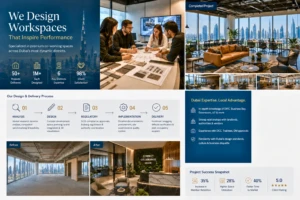
At Paras Interiors UAE, our co-working design expertise combines commercial design capability, regulatory knowledge, and deep understanding of Dubai’s flexible workspace market:
Our Co-working Design Process
- Investment Analysis: Before design begins, we help investors understand the financial implications of different design decisions—desk count optimization, zone allocation, and revenue per square foot analysis.
- Regulatory Navigation: We manage DM permits, civil defense approvals, and free zone requirements efficiently, preventing regulatory delays from impacting your opening timeline.
- Technical Integration: Our teams coordinate acoustic design, technology infrastructure, smart building integration, and MEP requirements as a unified design solution rather than afterthought additions.
- Phased Implementation: For investors converting existing commercial spaces, we design and manage phased fit-outs that allow partial opening while remaining areas complete.
- Material and Furniture Procurement: Our trade relationships across Dubai and international markets deliver quality at competitive rates, maximizing your fit-out investment.
- Complete Turnkey Delivery: From concept through opening day, we deliver complete co-working spaces ready for member occupancy.
For comprehensive commercial design expertise, explore our office interior design Dubai and commercial interior design Dubai services.
Conclusion: Design as the Foundation of Co-working Investment Returns
Dubai’s co-working market offers a genuine investment opportunity for those who understand that design quality isn’t a cost to minimize; it’s the primary determinant of competitive positioning, member satisfaction, and financial performance.
The spaces achieving 85%+ occupancy at premium pricing in Dubai aren’t winning through location alone or marketing budgets. They’re winning because members genuinely want to work there—because acoustic environments support productivity, technology infrastructure meets professional expectations, collaborative zones create community worth belonging to, and the overall experience justifies the investment of membership fees.
For investors approaching this market, the critical insight is straightforward: the difference between a well-designed co-working space and a poorly designed one is the difference between a thriving business and a perpetually struggling one. In Dubai’s competitive flexible workspace market, design mediocrity isn’t just aesthetically disappointing; it’s financially ruinous.
Ready to design Dubai’s next exceptional co-working space? Contact Paras Interiors UAE for an investment-focused design consultation. We’ll help you create a space that members love, regulators approve, and financial models celebrate.
FAQs - Co-working Space Interior Design in Dubai
The investment depends on your quality tier:
- Economy: AED 8,000–12,000 per desk (AED 300–450 per sqft)
- Mid-range: AED 12,000–20,000 per desk (AED 450–650 per sqft)
- Premium: AED 20,000–35,000 per desk (AED 650–900 per sqft)
- Luxury: AED 35,000–60,000+ per desk (AED 900–1,500+ per sqft)
For a typical 5,000 sqft premium space, expect AED 2.77–4.47 million in total fit-out investment, including construction, furniture, technology, acoustics, and regulatory permits.
A premium 5,000 sqft space (120 desk equivalent capacity) can generate:
- Monthly revenue potential: AED 382,000 (combining hot desks, dedicated desks, private offices, and meeting room bookings)
- At 75% occupancy: AED 286,500/month
- After operating costs: AED 66,500–106,500 monthly profit
- Payback period: 2.7–4.4 years
Premium spaces command 40–60% higher membership rates than basic competitors, making quality design investment financially justified.
World-class co-working spaces require six strategic zones:
- Collaborative Hub – For meetings, networking, and brainstorming
- Focus Work Areas – Quiet zones for individual productivity
- Acoustic Focus Pods – Private booths for calls and video conferences (AED 8,000–35,000 each)
- Meeting Rooms – Bookable private rooms generating AED 100–600+ per hour
- Dedicated Desk Areas – Permanent assigned workstations
- Private Office Suites – Lockable offices generating 3–5x revenue per sqft
Allocate minimum 15–20% of space to meeting rooms; increase to 25% for premium positioning.
Acoustic design is the single most important technical element—and most commonly underinvested area. Poor acoustics make co-working spaces unusable for serious work, leading to cancellations and negative reviews.
Essential acoustic solutions:
- Sound-absorbing materials (ceiling tiles, fabric panels, acoustic baffles): AED 150,000–250,000
- Sound-blocking partitions and acoustic-rated doors
- Electronic sound masking systems: AED 50,000–200,000
Investment return: Spaces with excellent acoustics achieve 85%+ occupancy and justify premium pricing.
Compliance is non-negotiable and affects design significantly:
- DED Licensing – Commercial licensing as business center/serviced office (affects reception, bathrooms, fire safety)
- Dubai Municipality Permits – Fit-out, structural, MEP, and fire suppression approvals required
- Dubai Civil Defence – Fire exit widths (minimum 1,200mm), emergency lighting, sprinkler coverage
- DEWA – Electrical load approvals
- Free Zone Requirements – Additional approvals if operating within DIFC, DMCC, Dubai Internet City, etc.
Timeline: Regulatory approvals typically add 4–8 weeks to project schedules.
Business Bay – Prime co-working district; younger, tech-oriented members; high SME density; accessible premium rates
DIFC – Highest specification expectations; premium pricing justified; legal and financial services professionals; marble and luxury materials standard
Dubai Marina & JBR – Lifestyle-oriented; digital entrepreneurs; outdoor terrace integration valuable; Instagram-worthy spaces drive marketing
Dubai Internet City & Media City – Tech and media professionals; podcast studios and content creation spaces; highest technical specification
JLT – Value-oriented; mid-range specification; cost-conscious SMEs and startups
Downtown Dubai – Premium lifestyle positioning; international visitors; prestige commanding premium pricing
Each location requires tailored design strategies to match member profile and achievable pricing.

Sandeep Joshi

As Marketing Manager at Paras Interiors UAE, I bring 10+ years of experience in brand strategy and digital marketing within the luxury interior design space. I craft impactful narratives that showcase our bespoke projects from elegant villas in Palm Jumeirah to premium commercial spaces in Downtown Dubai-highlighting the artistry and functionality that define our brand.